Write On! Features: A Writer’s Journey by Kate Beales
- 27 February 2026
- News, WriteOn Features
Like so many writers, I’ve been telling stories for as long as I can remember. At primary school, I got into trouble because we had to write a regular Monday diary recounting our weekend’s activities and I found that far too boring, so I made up adventures instead! I’ve always loved using the cinema of my mind to create atmospheres and worlds. Unfortunately, I wasn’t always so clear when it came to narrative structure. Lots of my early stories floundered because, although I could imagine characters, I wasn’t great at working out what was supposed to happen to them, and I lost confidence because I knew they weren’t strong enough to stand up alongside all the incredible novels I was reading. I’d also get drawn into the voice and style of the last author whose work I’d read and loved, so I didn’t feel I had anything authentic or original to say. I got into trouble at primary school another time, for copying out my favourite scene from Bambi’s Children rather than writing an original story, because I knew I could never write anything as good!
So I focused on plays and films, as well as other visual media such as art, photography and dance – they all tell stories. I became a theatre-maker. As well as directing plays, I spent more than three decades creating theatre projects based on adaptations, personal histories and devised narratives. In the nineties, I trained in oral storytelling with the brilliant storytellers Daniel Morden and Jan Blake, and I’ve been teaching storytelling ever since. All day, every day, I was practising my craft.
One day, out of nowhere, everything changed. I remember the exact moment I started Broken Horses: New Year’s Eve, 2012. I was on holiday with my family. We’d planned to go out to see some fireworks, but long before midnight, my husband and children had fallen asleep on the sofa! I wandered about by myself for a while, trying to find something to do, then sat down at my laptop and, without thinking, wrote the first scene of Broken Horses. That was it.
From that first moment, I knew the bones of the story I wanted to write. I had a narrative I believed in and characters whose voices were clear in my head. Eight years of writing and research followed. I worked in every spare moment, taking advice along the way from generous and supportive friends, beta-readers, writing groups and book doctors. I’m used to teamwork and like to bounce my ideas off other creative thinkers. It’s important to get the timing right, though. When I asked for advice too soon, I lost confidence in my own instincts. Too late, and I was wedded to my material. I learned to let my readers know exactly what I was looking for, from friendly encouragement to a really detailed critique. And to ask for the kind of feedback I knew each individual would understand and could deliver!
The process took years. I had a lot to learn as a writer. I was investigating a far-off story world and had a very busy day job, which also occupied the creative part of my brain. From the start, I drew heavily on my theatre practice. I love improvisation and rehearsal; I listen to my characters’ voices in my head and picture their movements and expressions. I experiment with different scenes and voices – almost as if moving the characters around on an imaginary stage. I didn’t mind that the process took a long time. Nobody was waiting for the novel, so I could afford to get it right. I wrote in bursts, between theatre jobs. I felt guilty when I didn’t follow all the advice and write regularly but. after a while, I gave up the guilt because my process was working. However you choose to write, the main thing is to “build a creative spine” (as Natalie Goldberg says), so whenever it’s time to jump back in, the creative muscles are at the ready. I was working on stories in my day job, so I knew I was furthering my craft even when I wasn’t at my desk. I also nurtured the project by reading, watching films, going to galleries and listening to music. I have a Broken Horses playlist and, to this day, whenever I play those songs, I’m straight back in the story.
Broken Horses was finally ready for submission to agents (or so I thought) in 2020 – I sent it out during the early months of the pandemic; fortunate, in a strange way, to be insulated from the usual highs and lows of submissions, as there were far more important things going on in the world. The process is not for the faint-hearted. I received a huge number of rejections and a fair amount of ghosting; including from incredibly friendly agents who requested the full manuscript, promising to read and get back to me within days, only to then fall silent and disappear. I treated it as a game and, mostly, had fun. I told myself rejection meant the agent wasn’t right for the book, so it was a positive thing. I’ve seen a lot of auditions over the years – great actors don’t get seen for parts they’d be perfect for and, when they do, they miss out for all kinds of reasons that have nothing to do with the quality of their work. I’ve turned down actors I’ve absolutely loved, so I know it’s not personal.
In the end, I got a wonderful agent with a great list, which I was proud to be part of. He was thorough, thoughtful and challenging, pushing me to make the manuscript better. We spent a year working on the ending – I must have tried at least five different versions before we found something we thought was right. Broken Horses went out to publishers in 2022. I was so excited; my agent really believed in the novel, and had high hopes… but nothing came back. The responses were warm; there were no concrete criticisms. On the contrary, I received praise for my writing, but nobody could see how to sell the novel. I found these rejections difficult. The stakes felt higher; I was closer to the goal of publication and had an agent who believed in the book. And yet, editor after editor said No. After several months of disappointment, my agent announced his retirement, and that was the end of Broken Horses. It seemed my only option was to write another novel and start all over again.
Except I couldn’t quite bring myself to give up. I did start another novel, but Broken Horses was still in the back of my mind and I couldn’t let it go. One of my mentors finally challenged me to look deeper into what I wanted for the book. Reflecting on the question: “What does success really look like for you?” I realised that I couldn’t give up on Broken Horses. I love books so much, and I wanted a beautiful physical edition of the novel. So I began exploring alternative publication options; I asked around and took advice on both self-publishing and small traditional indie publishers. In early 2025, I submitted to two publishers who don’t require submission via an agent and received interest from both. I was immediately drawn to Linen Press, a tiny-but-mighty feminist press with a list I admired, prepared to take risks for books they believed in.
The submission wasn’t an instant success: Linen Press wanted me to rewrite the ending I’d spent a year working on with my agent. In the spirit of rehearsal, I decided to give it a try. The rewrite turned out to be easy; the new ending felt very natural, flowed well and made the book better. From there, things moved very quickly. The publisher was generous in sharing the creative decision-making, and I was involved in all aspects of the book’s design. As a theatre-maker, I am used to being part of a creative team, and I absolutely loved working with the amazing typesetter and printers to see the physical book through to publication. I’m also lucky that my son is an artist; he designed the book’s beautiful cover, so the entire process felt intensely personal and creative.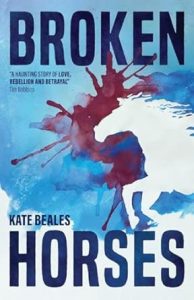
After a journey of more than a decade, I am overjoyed that Broken Horses is out in the world. I’m not done. I’m still figuring out how best to reach potential readers while working on my second novel. But I’ve learned so many important lessons: that there are myriad routes to publication and I need to be open to them all. That it was important to know what success meant – for me. That my support team is vital. And that with patience, hope, and belief in the work, I can get there in the end.
*****
Kate is a writer, theatre-maker and facilitator, working with communities across the UK and around the world. She has been a Senior Artist and Freelance Associate in the National Theatre’s Learning Department for 29 years.
She has worked with refugees on the streets of Paris and Athens, collaborated with a photographer to build pop-up darkrooms for storytelling projects, and made participatory shows with two-to-five-year-olds in a giant bed. She co-devised theatre-based training for doctors in Osaka, and taught storytelling for Medical Humanities at Bristol University. For twenty years she was a lecturer in Shakespeare and Storytelling at New York University’s Tisch School Of The Arts in London.
She currently creates theatre, writing and storytelling projects for wounded veterans, teaches storytelling to senior executives around the world and devises creative workshops for writers and other artists.
You can find out more about Kate Beales here: linen-press.com/new-signing-broken-horses-by-kate-beales/ and connect with them on Instagram: @kate.beales
Broken Horses is available from the Linen Press website and Amazon.
*****
Issue 27, featuring eco-poet Sarah Westcott is out now. You will be able to find it in libraries and other outlets. Alternatively, all current and previous editions can be found on our magazines page here.
You can hear great new ideas, creative work and writing tips on Write On! Audio. Find us on all major podcast platforms, including Apple and Google Podcasts and Spotify. Type Pen to Print into your browser and look for our logo, or find us on Podcasters.Spotify.com.
*****
If you or someone you know has been affected by issues covered in our pages, please see the relevant link below for information, advice and support: https://pentoprint.org/about/advice-support/
Related News

Showcase: Two Sides To The Same Story + Happily Ever After + Pound Hugs
- 30 August 2023
- News, WriteOn Showcase