Monday Moments: Non-Linear Lives Well Lived
- 2 November 2026
- Monday Moments, News

Our theme this month continues to be ‘Fractured’ and, as we find ourselves battling the elements here in the UK, I’ve been thinking about the many paths our lives can take.
The recent stormy weather has heralded winter’s fast approach and, with it, the end of another year. January will mark my fourth year as an Associate Editor at Write On! which I’m delighted and so grateful to share. In that time, my life has re-routed itself in all sorts of ways, landing somewhere I never thought it would.
When I first began volunteering with Pen to Print, I was finding my voice – both on the page and off. I’d come to a fork in the road, knowing only that I didn’t want to keep doing what I’d been doing, and finding solace in putting pen to paper. In the last four years I made some strides and did lots of side-stepping, finding my special person in the process.
Life has a way of surprising us, sometimes in the best possible way. But our paths are never certain. So, all we can really do is forge ahead with good intentions, knowing what we know at the time. There’s never just one route towards a life well lived: there are a million different ways to build it. Non-linear journeys – what we might term ‘fractured’ life paths – are part and parcel of what it means to be human.
This month’s pieces draw on unconventional paths, non-linearity, and serendipitous journeys homeward.
First, Vic Howard reflects on what makes a memorable life, citing experience – and a few regrets for good measure – as being essential for truly living.
The Good Life
Wouldn’t it be fun if we could live our lives in reverse? Old age brings a sudden knowledge of all the things we should have done when life was easy. All those lost opportunities become frustratingly clear when our worn-out body is past being able to replay the experiences. All that good advice we were given but laughed at and ignored becomes crystal clear when it’s too late to take it seriously. This is the curse of free will.
But if we started life with full knowledge of all that good advice, and the knowledge that would be gained through trial and error, we ought to be able to make a better job of it. However, and there’s always a however, we would gradually forget it all as we lived our life, and we would end up with an empty head – akin, perhaps, to what Alzheimer sufferers experience.
Maybe the old way is best after all. Better to have a lot of memories and a few regrets, than none at all.
The best trick to a good life is to try everything and not be afraid. The regrets you will be left with will be the things you never got around to trying. All the things you did, sometimes with success and sometimes without, are what constitute a memorable life.
© Vic Howard, 2026
*****
Next, Nicole Brown writes about the intricacies of knowing another person intimately, and the winding paths our relationships can follow.
Terms
You said my woman
before I had a name for you.
When your name came back wrong in other mouths,
I corrected it.
You knew what they made of mine.
Still, you spoke to them and named me:
First love.
Love of my life. My woman.
You knew how to dress what you had opened.
I love you.
When the hurt came back with my name on it,
you recognised it at once.
By then, I heard the pause you never made:
my-woman.
You said it whole.
I couldn’t.
© Nicole Brown, 2026
Connect with Nicole on X and Instagram: @iamnbrownn
*****
In this final prose piece, Andrea Cunha writes about a connection between her homeland and Charles Darwin’s revolutionary work, On The Origin Of Species, reflecting on humanity’s search for meaning, knowledge and deeper understanding.
What Does Charles Darwin Have To Do With Me?
I’m known for being a storyteller – though, truth be told, I don’t believe I’m particularly talented at it. But I do try my very best and one thing I can’t deny: I certainly have stories to tell, not because I went looking for them, but because they came to me quite naturally.
During the August holidays, I went to visit Brazil. Sitting in my mother’s living room, sipping a cup of coffee and eating homemade apple cake, we were chatting with the neighbour, who remarked: “How can a girl so young have so many stories to tell?” My mother smiled and agreed: “It’s true, she’s already lived through and experienced so much.”
Back in the UK, sitting with my laptop, I found myself wondering what I could write about for the month of November. I remembered that, in this very month, on the 24th exactly 167 years ago, Charles Darwin published his book On The Origin Of Species By Means Of Natural Selection, which turned out to be a genuine bestseller of its time. The entire initial print run of 1,250 copies sold out on the very first day!
But what does Charles Darwin have to do with this Brazilian writing to you now?
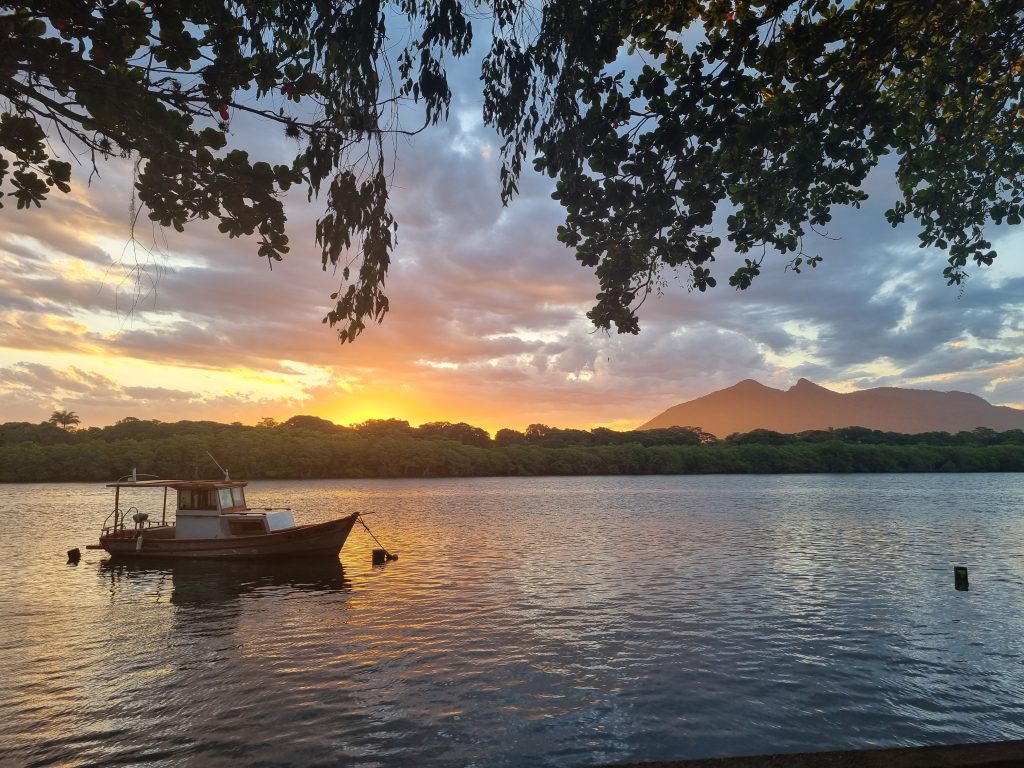
The answer is that, nearly two centuries ago, Darwin, a young English scientist, set sail aboard HMS Beagle on a journey that would open up new horizons for human understanding. I find it so interesting that, during his time in Brazil, he navigated the São João River – the very same river flowing just behind my home!
Aged just 22, Darwin departed from the United Kingdom, bound for the Southern Hemisphere, utterly fascinated by the exuberant beauty of our land and the astonishing variety of animal and plant species. Over five years, he explored not only Brazil, but also Chile, Argentina, Peru, Uruguay, Ecuador and Australia.
His meticulous observations were fundamental to formulating his revolutionary theory in On The Origin Of Species, challenging previous conceptions and establishing the principles of evolution by natural selection.
This is why, every time I sit by the banks of that river in Brazil, I can’t help but imagine what this place was like nearly two centuries ago. Driven by scientific curiosity, Darwin found inspiration in every corner of nature, honing his observational skills and shaping his understanding of the world.
The voyage of the Beagle has been by far the most important event in my life, and has determined my whole career, he later wrote. His methodical approach and passion for investigation left a legacy that continues to inspire us today.
Beyond science, Darwin’s story also serves as a reminder of the importance of meaningful knowledge in a world where we so often lose ourselves in trivialities. In times of debate and diverging views, his journey reminds us of the need to value freedom of thought and education.
As I contemplated the beauty of the river on those sunny days at my mother’s house, I was invited to reflect not only on Darwin’s expedition, but on our own search for understanding.
© Andrea Cunha, 2026
*****
Header Image: Photo by Nicole Moore on Unsplash
*****
Issue 30, featuring Gillian McAllister is out on Friday 11 September. You will find it in libraries and other outlets. Alternatively, all current and previous editions can be found on our magazines page here.

You can hear great new ideas, creative work and writing tips on Write On! Audio. Find us on all major podcast platforms, including Apple and Google Podcasts and Spotify. Type Pen to Print into your browser and look for our logo, or find us on Podcasters.Spotify.com.
*****
If you or someone you know has been affected by issues covered in our pages, please see the relevant link below for information, advice and support:


