
Edited by Jaclyn Rajsic
Welcome to my final Showcase! This week, we continue to explore the damages of fracture, this time through violence and war and the natural and supernatural.
Our first two pieces reflect on fractured identities in the face of death and war. The first beautifully contrasts darkness and light as yellow – the only colour – hauntingly blends candlelight with golden coffins.
The Becoming
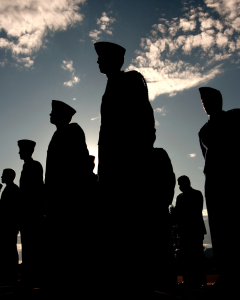
I saw them come forward
their hands raised above their heads,
bearing a certificate of their appointment
as the next candidate to sit for death
over those with a destiny to live,
those whose source of life is living.
They moved forward,
their faces dark, their eyes grim, closed
their lips tightened like a parcel
marked out for a distant delivery.
They had no movement except motion,
and no smile except the parting of their lips.
In their hands were candles,
gleaming in the dark like yellow tongues,
like glazed, golden coffins
their foreheads pierced the night like spears
that slaughter the tormentor of their body
and shake out their grief from their souls.
They have survived their wounds,
those who fed on the garbage of the sky,
those who carried their coffins on their heads,
who ate grass and sand of the field,
but the rain struck, and there was lightning,
and they watched their sorrows scatter.
(c) Jonathan Chibuike Ukah, 2026
Connect with Jonathan on Facebook: @chibuikeukasoanya and LinkedIn: JohnKing1502@LinkedIn.com
*****
Red is the colour I see in our next piece, which powerfully explores how the horrors of war fracture a person. Sounds and senses stir emotions and spark meditations on mortality and identity. Perspectives shift as the seconds slip by.
60 Seconds
0
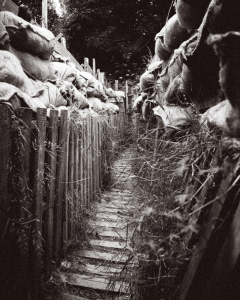
The silence was the sound of his own thoughts and a distinct sound inside his head. He suddenly remembered his mother placing a shell to his ear. A tear fell.
Then the smell reached him. He couldn’t place it. He didn’t know it yet – the smell of death: rotting flesh, blood, stagnant water, cordite. It had no beginning. It would have no end.
He watched his tear fall to the ground; thick mud crushed by boots. The rain mixed with blood formed around his own.
Something moved and broke his concentration. A rat. Rats which fed on fallen comrades roamed the trench oblivious to the horrors above. A pang of jealousy swept through him. The rat was free: free of orders, free of knowing death was just moments away.
He looked up towards the ladder. ‘It will carry many a foot and will be here as long as it wants. It’s free.’
The rain gently fell down the side of the trench, leaving behind a shine.
‘Will I disappear into the earth? Will anyone know?’
He gritted his teeth as they started to rattle, but that only made his shoulders shake. The feeling ran down his arms, into his hands. He tried to clasp them against his weapon.
‘Please,’ he begged his body. ‘I’m not a coward. I want to run. But I’m not a coward. Or am I? What am I?’ His throat tightened as tears started to form.
His hand felt a sudden touch; a strange warmth. He looked down to the hand of the soldier next to him, his hand resting on his.
Just a year older than his own 18 years, this soldier’s hair was white, his face heavily lined, eyes sunken to almost black, as though they were protecting him from something.
He looked at him. Gripped his hand. Smiled.
His hands stopped shaking. He finally breathed out and the tension within disappeared into the fog.
Then the hand was gone.
15
The sound of muffled sobbing turned his head. This soldier was just 16 years old. He’d lied to seek adventure. He’d never been to Europe, and doubted he ever would, so he’d grabbed the opportunity. He and his friend had sneaked on a train from London, full of joy. Looking as though he’d put on his dad’s tunic and picked up a toy gun to play in the fields with his friends.
The weight of this horror was too much to bear, yet still he tried desperately to muffle his tears. Someone else stood beside him, tunic ripped and bloodied, its buttons bursting from the size of him. He rested a large hand on his shoulder.
The gaze shifted past the fellow who’d grabbed his hand. Someone was hunched over; the sounds of retching echoed through the trench. Someone checked his rifle, then checked it again. He realised his own arms were shaking. Nonetheless, he checked his as well.
Laughter, but it was off. Teeth grinding from another.
Someone held out a cigarette. It hooked between his lips. Another was trying to light it, but his hands were shaking. Finally, it lit. They shared it between them.
Everyone seemed to have their own ritual. Checking buckles, reloading a gun over and over. Some were different. Blood-red faces. Eyes never looking away from the ladder, hands clasped tight, as if they couldn’t wait to go.
30
His hands had stopped shaking and they now held the ladder in front of him.
The frantic beating of his heart had stilled and knuckles that were white from clenching the rifle had returned to their normal colour. He looked down. The rat had long gone.
The mud, the rain, were not so vibrant; merely present now. The smell was just as ripe and he was still trying to understand what it was.
Daybreak was close. The fog had become whiter. The day would come. Not all would see it end.
It was what it was.
Putting a hand in his pocket, he pulled out a picture of his mother and father. They stood in front of the garden gate. Mum was smiling, wearing her apron — she’d never been without it. His father stood tall, chest puffed out, holding a pipe in his hand.
He hoped they were proud of him.
45
In years to come, this moment might make sense. Looking around at the soldiers he barely knew, a strange feeling of warmth enveloped him. Whoever they were, they weren’t turning back. And nor was he.
Though he wasn’t asked to, he placed a foot on the first rung. There was a defiance in him. It had come from the very mud he stood in, up through his legs, chest and head.
He looked around. Others heard. And slowly, they followed his lead.
‘Where’s that cowardice now?’ he was screaming inside. Gone, gone with that snivelling little rat, gone with that dour rain. What remained was the blood around his boot. Defiant in death.
Placing the next foot on the rung above, he heard something flap in a sudden gust of wind. He looked back.
The flag.’Our flag. My flag,’ he thought.
Colours pierced his heart like a spear. He pulled another boot, then another.
‘Who are you?’ screaming welled up from inside. “I’m brave!” he yelled. “I’m brave and don’t you ever forget it!”
He turned towards the 16-year-old. He was level on the ladder, and looked at him with gritted teeth and a smile. The tunic was now a perfect fit.
With eyes upon him, he opened his mouth. Just as the whistle began to blow.
“Let’s give ‘em hell, lads!”
(c) Gary Rowlatt, 2026
Connect with Gary on Facebook: @BackAlleyPress and on Medium: @gjrowlatt
*****
Yellow and red are signs that summer has given way to autumn. Time and seasonal change are central to our next piece, which comically calls attention to climate change. Humans and technologies fracture nature’s cycles when a computer program fails to be executed.
Autumn.exe
“Just curious, did you run Autumn.exe on the first of October?” Ben asked Helen, the administrator from the Seasonal Adjustment Department, SAD. “It’s just that we’re getting complaints that the weather is too summery for the season.”
There I was thinking it was summer’s last hoorah. But come to think of it, it did seem rather too sunny. The leaves hadn’t started to turn yet, and it was way too dry for October.
Helen moved her mouse frantically, clicking it like machine gun fire and then typing in a slow ‘hunt-and-peck’ style using only her index fingers.
“A-u-t-u-m-n-dot-e-x-e,” she said, “and search.”
The computer thought about it for a while.
“Aha, here it is,” she said excitedly. “Seasonal adjustment of summer 2026 to autumn 2026, submitted on August the 23rd, reviewed by Barry on the 29th, approved by Susan on the 30th and assigned to SAD on September 1st. Looks like it is still sitting in the to-do queue.”
“Still in the to-do queue,” Ben said.
“Yeah, it’s this new system corporate implemented. Supposed to work better,” she said, rolling her eyes. “We keep losing tickets. The paper job sheets never got lost. They just got buried, which is different.”
“Can you not just do it now?” Ben asked. “The migratory birds are all up in a tizz. They don’t know whether they’re coming or going.”
“Sorry, I don’t have access. It’s assigned to Larry and he’s off for a while after he took a tumble last week.”
“Can’t anyone else run it?”
“Larry’s the only one with the login. It’s on a Post-it note on his monitor, and the monitor is at his house.”
Larry, so I’m told, miscalculated his step when moving from one cloud to the next. He slipped and ended up kissing the surface of the Earth. We’re lucky he’s alive.
But he won’t be eating solids for a while.
(c) Wilco van Kleef-Bolton, 2026
*****
To conclude, we move from October’s beginning to its end. Our last piece feels fitting for Hallowe’en as it explores witchcraft and magic in history and literature. As a medievalist, I love the references to Arthurian legends. Arthur’s kingdom ultimately falls, fractured from within. Repair is urgent in our troubling political times. Or will more things wicked this way come?
Something Wicked?
Witchcraft and politics may appear to be an unlikely pairing at first glance, but they’re historically intimately intertwined. I was reminded of this the other day as I read the latest updates on a decades-long spat I’d watched unfold between covens representing opposing ends of the political spectrum overseas – advocating their sides by way of binding spells, hexes and all manner of mischief.
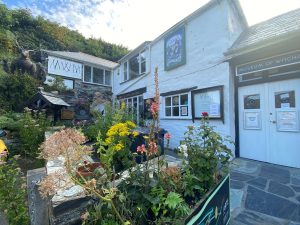
It was ever thus. During the turbulent anti-war marches of the 60s/70s witches were getting arrested for things like attempting to levitate the Pentagon building (unfairly arrested I’d say, as they had already been granted a permit to do so!). Or further back to WW2, when according to Gerald Gardner (a prominent British Wiccan leader), a New Forest coven took part in an anti-Nazi ritual in August 1940 to repel the Luftwaffe from landing on British soil. Back then, British witches even made poppets of the Führer to torment him, some relics of which still exist in places like The Museum Of Witchcraft And Magic in Boscastle today.
And why should it not be the case? Magic is, after all, older than religion or science. The first known mention dates back to what is considered the oldest surviving great work of literature, The Epic Of Gilgamesh, in which Gilgamesh seeks the elixir of life. Witchcraft is found in the Sumerian poem Enmerkar And En-suhgir-ana (c. 2112–2004 BCE), which follows a tale of rivalry between two kings over the goddess Inanna, a deity of magic and war.
Woven throughout our histories are the stories of powerful and magical women and men. Some are fictional like the witch in Goethe’s play, Faust, who brews a potion to transform the old scholar into a lustful young man. Or, Shakespeare’s Weird Sisters in Macbeth, with the ability to see into the future. In fact, one of our own island’s most enduring folk tales of Arthur and his knights is littered with magical elements. The main protagonist famously kept the council of Merlin, a powerful sorcerer, and came into deadly conflict with Morgan le Fay, a fearsome enchantress, as well as the Lady of the Lake, the bestower of magical weapons.
If only the real world were as fond of powerful women as the realms of historical fiction, for littered just as extensively, like a ghastly inverted universe to our wonderful folk tales, is the documented persecution of women (not exclusively, but in vastly larger numbers) for the crime of witchcraft. This harassment and torment has travelled with us through time and across borders and is still present today.
To close, I’m reminded in these politically volatile times that, in its satirical critique of blind faith and bureaucracy, Monty Python And The Holy Grail once declared: “Strange women lying in ponds distributing swords is no basis for a system of government!”
Nowadays, I’m honestly not so sure if that wouldn’t be a better option for us!
(c) Kate Stallwood, 2026
Photo taken by Kate Stallwood
*****
Thank you for joining me on this journey through ‘fractured’!
Connect with me on Instagram: @londonlegendsmedieval
Page Header Image from Unsplash (c) Bruno Souza
*****

You can hear great new ideas, creative work and writing tips on Write On! Audio. Find us on all major podcast platforms, including Apple and Google Podcasts and Spotify. Type Pen to Print into your browser and look for our logo, or find us on Podcasters.Spotify.com.
*****
If you or someone you know has been affected by issues covered in our pages, please see the relevant link below for information, advice and support: https://pentoprint.org/about/advice-support/


