Write On! interviews Marcella Marx
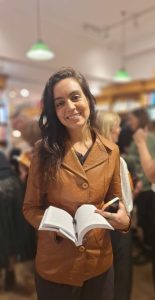
Marcella says “I’m a Brazilian-born writer and educator based in London. I write fiction exploring identity, belonging and the complexities of relationships and place. I’m the co-founder of the postgraduate Creative Writing course at Belas Artes College in São Paulo and a fellow of the London Library Emerging Writers Programme. I hold an MFA from Birkbeck, where I studied under Dame Marina Warner. My fiction has been shortlisted for the Guardian 4th Estate Prize, longlisted for the Berlin Writing Prize, and named a finalist for the Tennessee Williams & New Orleans Literary Festival Prize. My work has appeared in The Georgia Review, Queer Life, Queer Love III, and The London Library Anthology. I’m currently working on my second novel.”
WO: How would you describe your writing to someone new to it?
MM: I write about the stories we inherit without knowing it, the disguises we adopt to survive and the lives we might have led if history had taken another turn. My writing is immersive, richly textured and intentional, exploring the histories that shape us, the silences that define us and the identities we construct in order to survive. My characters are flawed, contradictory and deeply human. I want readers to recognise something of themselves in them, not in spite of their imperfections, but because of them. At the heart of my work is a fascination with the tension between who we have been taught to be and who we might yet become – and with the possibility of reclaiming the lives we never thought we could lead.
WO: Can you tell us a bit about your latest book, Invisible Animals?
MM: Set in the imaginary country of Pindorama, Invisible Animals follows four women — Maria, Joana, Ruth and Tereza — across generations and social divides, in a world shaped by colonisation, exploitation and dictatorship. Bound by family, work, inherited stories and their own quiet rebellions, they navigate the expectations and power structures that seek to define them.
At the heart of the novel is the idea of camouflage: in nature, blending in can be a means of protection, a strategy for survival, even a way to hunt. But what happens when the disguise becomes indistinguishable from the self? Through stories passed down from mothers to daughters, animals become emblems of concealment, resistance and the peril of disappearing into the roles imposed upon us. Invisible Animals explores the power of storytelling and words to shape the lives we inhabit and their potential to help us imagine, reclaim and give voice to the lives we might otherwise never have lived.
WO: What inspired you to write in the first place, and what inspires you now?
MM: I have always been inspired by people: those I know intimately and those who cross my path, sometimes only briefly. Knowing someone deeply allows me to glimpse the contradictions beneath the surface, the private struggles, unspoken fears and small acts of courage that make us who we are. Those who pass through my life offer different kinds of inspiration: a gesture, a conversation, a fleeting observation that stays with me long after the encounter has ended. I am drawn to what people reveal, what they conceal and what they may not yet understand about themselves. These glimpses of human complexity find their way into my writing, where I can explore the questions they leave behind.
For Invisible Animals, I drew inspiration from the women who have surrounded me throughout my life: those who taught me how to blend in to protect myself, and those who taught me to stand up for myself. Their influence made me think about the delicate line between adaptation and self-erasure, between learning to survive within the world as it is and finding the courage to challenge it. I think I write, in part, to understand these contradictions and to give space to the stories, silences and possibilities that might otherwise remain unseen.
WO: Recently, Write On! explored the theme of Nostalgia, reflecting on the often rose-tinted view we have of the past. How important do you think it is to acknowledge what came before in your own writing? Or do you think nostalgia can hold you back from moving forward?
MM: I feel a deep gratitude towards the writer I was when I first started. For her determination to persist, to keep writing and to believe in the stories she wanted to tell. Yet it’s never easy to revisit old work. Often, it feels like encountering a version of yourself you’ve since moved on from, someone you recognise but no longer entirely are. So, for me, looking back on my writing isn’t necessarily rose-tinted. What I feel is not nostalgia for what has been but a nostalgia for what’s coming next, for the writer I’m becoming and the stories I have yet to tell.
WO: What one piece of advice would you give an aspiring writer?
MM: It took me a long time to understand this… You can only become better at anything if you don’t mind doing it again and again and again. Writing and rewriting. Reading and rereading. It’s simple,but hard-earned. You can’t be better at something by doing less of it.
WO: Can you tell us anything about future projects?
MM: I’m currently working on a short story for an upcoming collection that explores the relationship between the body and the city, drawing a parallel between London, where I live, and São Paulo, where I was born. I’m interested in imagining the city as a living organism, one that suffers, stumbles and bears scars, much like the bodies we inhabit. The wounds we inflict collectively on the places we live in echo, in many ways, the wounds we inflict on one another and those inflicted upon us. I want to explore how these scars shape not only the places we inhabit, but also the ways we inhabit ourselves.
WO: Lastly, if you could choose one fictional animal/creature to be a pet or companion, who would it be and why?
MM: I would be Ulisses, the dog of Brazilian writer Clarice Lispector, who appears in her posthumous book A Breath Of Life. In the book, she points out that Ulisse feels everything except the notion of the future. I think living more in the present is a great gift.
You can find out more about Marcella Marx here and connect with them on Linkedin. Invisible Animals is currently being edited.
*****
Issue 30, featuring Gillian McAllister is out now. You will find it in libraries and other outlets. Alternatively, all current and previous editions can be found on our magazines page here.

You can hear great new ideas, creative work and writing tips on Write On! Audio. Find us on all major podcast platforms, including Apple and Google Podcasts and Spotify. Type Pen to Print into your browser and look for our logo, or find us on Podcasters.Spotify.com.
*****
If you or someone you know has been affected by issues covered in our pages, please see the relevant link below for information, advice and support: https://pentoprint.org/about/advice-support/