Showcase: I Remember, I Remember + Vintage (Extract)
- 3 June 2026
- News, WriteOn Showcase
Edited by Gloria Maloney
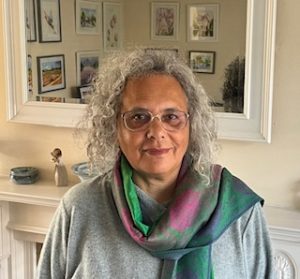
Hi, I’m Gloria Maloney and I’m your Showcase Editor for June.
I’m a poet, artist and musical performer, attaining Grade Eight distinction on the oboe in my youth. Because I developed arthritis in both wrists, I now play the recorder, much appreciated at my folk club, Toot Hill.
My poetry and prose generally reflect my enduring love of music and nature, with painting being another means of expression for me. In fact, it often inspires my writing.
I retired in 2020 and finally fulfilled my dream of writing. In 2021, I was honoured with first prize in the Pen to Print Poetry Competition and have since returned as a judge, most recently in 2025.
I’ve also been published in various online and print magazines and was awarded second place in the Barn Owl Trust anthology Empowering Earth, Volume 8 (2026).
I spent my early years daydreaming, escaping into fantasy books and walks in the countryside with my parents. Their love of the natural world has stayed with me through all of life’s twists and turns. Its beauty never fails to astonish me, in both the grand and the small miracles of everyday life.
As we journey through the summer month of June together, we’ll be exploring how we borrow from music, nature, memory and time itself.
Some of what we borrow comes quietly from childhood and stays with us for life. One of my earliest memories, at around six years old, is of my father sitting beside my bed reading from his old grammar school poetry book, The World’s Classics. I especially loved Thomas Hood’s poem, I Remember, I Remember. I would close my eyes and picture myself in the beautiful garden, the thrill of being pushed on a swing, up high into the tree tops.
I still have my father’s book today. Its pages are yellowed and worn with age, some lovingly taped back together, and it remains one of my most treasured possessions.
Here’s the poem for you to enjoy.
I Remember, I Remember
I remember, I remember
The house where I was born,
The little window where the sun
Came peeping in at morn
He never came a wink too soon
Nor brought too long a day
But now, I often wish the night
Had borne my breath away.
I remember I remember
The roses, red and white,
The violets, and the lily-cups
Those flowers made of light!
The lilacs where the robin built,
And where my brother set
The laburnum on his birthday,
The tree is living yet!
I remember, I remember,
Where I used to swing,
And thought the air must rush as fresh
To swallows on the wing;
My spirit flew in feathers then,
That is so heavy now,
And summer pools could hardly cool
The fever on my brow!
I remember, I remember,
The fir trees dark and high;
I used to think their slender tops
Were close against the sky:
It was a childish ignorance,
But now ’tis little joy
To know I’m farther off from heav’n
Than when I was a boy.
© Thomas Hood, 1827
*****
I’m a passionate reader and supporter of my local library, which at one point was under threat of closure. You can find me there, topping up my bulging supply of borrowed books. I’m currently reading Raising Hare by Chloe Dalton. A beautifully poignant autobiographical memoir about a wild leveret she rescued, raised and returned to the wild.
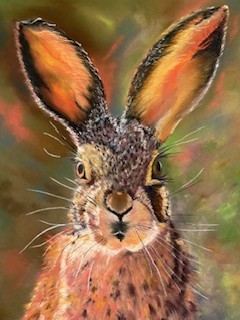
With this in mind, I’m sharing my painting of a hare with you. Created in pastels, I’m giving him a whimsical look! I was inspired to paint him after taking a walk across my local fields and watching the hares boxing.
*****
Next, we have a wonderful piece from playwright, Lucy Kaufman. She gives a lovely account of her play around the idea of borrowed time.
When I hear the phrase ‘borrowed time’ I immediately think of my short play Vintage, in which the two main characters are quite literally borrowing time by living their lives as if in a past era. David and Jenny are a married couple who seek couples counselling for their unusual issue: they are a modern couple stuck living on one particular day in 1942. David wants to move on but Jenny is happy living in WW2 where, for reasons explored in the play, she feels safe.
Vintage itself feels as if it is living on borrowed time. When I wrote it, in two days over 15 years ago, I had no idea of the life this 14-minute piece would go on to lead. Since 2010, my little play has been to multiple Edinburgh and Brighton Fringe festivals, toured Australia for six months and been performed by at least ten different couples that I know of in a multitude of venues including private parties, cafés and even corporate training sessions. In Lockdown, it managed to reinvent itself as a counselling session over Zoom and was videoed for YouTube. Some of the actors are couples in real life.
In the last year, it’s had something of a revival, performed by three theatre groups in six venues and winning multiple awards at Waltham Forest Festival, including First Place Best Play (thank you Woodhouse Players!). As I write, Vintage is due to be performed at the Eastern Finals in Oxted. By the time you read this, I’ll know if it’s been successful in going all the way to the All-England Finals.
Vintage is a play that investigates nostalgia. These days, it’s impossible for me not to feel nostalgic about Vintage.
Extract from Vintage by Lucy Kaufman.
JENNY: (to AUDIENCE) I know what you’re thinking. We need our heads banging together. We weren’t always like this. (Nostalgic, remembering) It started small-scale at first. One lunch-hour. It was raining. I was passing this little shop and thought I would shelter inside. It was like a musty museum vault filled with priceless antiquities: vintage clothes. The textures, patterns! Of a world long-gone. Quality, pure craftsmanship. Hand=made pieces as rare as vintage wines- I was intoxicated. Soon I was more than browsing. I had to make a purchase. I bought a bag, then a pair of shoes and one day plucked up courage to buy a whole outfit. Before long I had a wardrobe full. Then one time, I came across this poster: a 1940s tea-dance! My chance to mix with others like me. That’s where I met David.
MUSIC: ‘In the Mood’ plays softly in the background.
DAVID strikes a pose, takes JENNY’s hand and twirls her into a 40s dance. He pulls her towards him as part of the dance.
DAVID: (To AUDIENCE) I own a vintage gramophone record store.
JENNY: (To AUDIENCE) He simply oozed the past in his 1940s hats and suits. I had found my match.
DAVID: We had a terrific wedding.
JENNY: The dress! A vintage bridal gown
DAVID: Exquisite. Fitted her like a glove
SOUND FX: Church wedding bells
JENNY: Hand-stitched. No plastic fastenings or man-made lining.
DAVID: You could smell the history in that dress. Economy of the fabric, shortened hemline. The 40s underwear! Sensational!
JENNY: Stepping into that dress I was stepping back in time.
DAVID: And so it continued… Referring back to the past more and more, adding 1940s accessories until there was no going back. It was our life.
JENNY: People thought we were bonkers.
DAVID: We had to sit down (they sit) and make some tough decisions. Was it just the clothes, the music, or was it going to be more?
JENNY: (Energised) It had to be more. The house – we chose a village with few cars and just a handful of shops. The food, the cooking- we got a 1940s stove. There was the vintage car, no TV and only classic black and white movies.
DAVID: But then it spread. Illness: the drugs we could take. Presents: what we could buy people- what was available in the 40s?
JENNY: Make-up, hair-dyes, old-fashioned barbers. The lot.
DAVID: It was all going swimmingly-
JENNY: (suddenly serious) Until the War.
SOUND: Air raid siren.
DAVID: Bloody Hitler. Ruined all our fun. The 40s meant Wartime and rationing. We got a vegetable patch and chickens.
JENNY: I lived without stockings-
DAVID: I built a bomb shelter.
JENNY: We were under continual threat of attack. I was terrified.
DAVID: (With utmost gravity) We were absolutely authentic.
JENNY: We had to anchor ourselves- pinpoint exactly which date and year we were in so we could do the research: the events, the politics, what our attitudes should be.
DAVID: Jenny had bought herself a suit-
JENNY: Charcoal flannel- an original-
DAVID: So we combined the year of her suit with the date of our wedding: 30th October-
JENNY: 1942.
DAVID: It became our sacred rule.
JENNY: That it was perpetually 30th October 1942.
DAVID: That’s when the trouble began. I was 21. In 1942 I would have been called up to fight in the war. It wasn’t plausible that I was at home with Jenny so we invented a reason why I hadn’t gone to fight-
JENNY: That he was a conscientious objector-
DAVID: And had Jenny really been married in the 1940s, she would have started a family and yet we’d decided not to have children-
JENNY: So we made up a reason for no children- that I was barren.
DAVID: And these two things have all but destroyed us.
© Lucy Kaufman, 2010
*****
I look forward to sharing more lovely pieces with you next week!
*****
Issue 28, featuring author and historian Alison Weir is out now. You will be able to find it in libraries and other outlets. Alternatively, all current and previous editions can be found on our magazines page here.

You can hear great new ideas, creative work and writing tips on Write On! Audio. Find us on all major podcast platforms, including Apple and Google Podcasts and Spotify. Type Pen to Print into your browser and look for our logo, or find us on Podcasters.Spotify.com.
*****
If you or someone you know has been affected by issues covered in our pages, please see the relevant link below for information, advice and support: https://pentoprint.org/about/advice-support/