Showcase: Finding My Inner Cavewoman + Out Of The Cave + Leaving The World Behind + Watch The Birdie
- 17 June 2026
- News, WriteOn Showcase
Edited by Gloria Maloney

Hello, and welcome to my penultimate June Showcase.
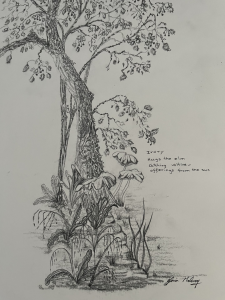
We’re looking at the theme ‘Borrowing’ from nature.
With that in mind, I’m delighted to share a charcoal drawing I did of an Elm tree with you.
*****
Next, and in keeping with this look at the natural world, my experience of the bushcraft day I attended with my local U3A group a few weeks ago. It brought me to a deeper understanding and connection to nature, with respect for the environment.
This piece is based on a personal experience, so do not to attempt to do any of it without expert supervision!
Finding My Inner Cavewoman
It was a balmy, sunny day when I arrived at the local scout camp field, where I met our two Scout Leaders who would be supervising us.
We had all brought along fresh ingredients: my contribution was thyme, mint, rosemary and sage foraged from my garden, plus a handful of home-grown tomatoes which I added to the harvest table brimming with onions, carrots, peppers, spring onion and leafy green salad leaves brought from allotments.
Our mission: to cook a tasty meal with the minimum number of utensils.
For our first task, we needed to stoke up the fire pit. This involved foraging for dry branches to use as kindle amongst the trees bordering the field. We identified the trees as mostly beech and oak. Both are good for slow burning and produce a low density of smoke, though I have to confess, my eyes did sting!
The fire pit had a large, old Victorian cast-iron boot mat laid over the logs; this served as our cooking surface.
We then cooked breakfast: bacon rashers, mini sausages and tomatoes assembled on wooden skewers and placed in the pit. When we had eaten with gusto, the skewers were added as kindle in the pit.
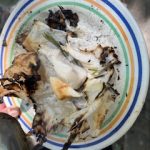
Fortified with breakfast, we then prepared our main meal. The sea bass was garnished with herbs, wrapped in newspaper parcels, dunked in a bucket of water and then laid under the fire pit mat around the smouldering logs.
We scooped out large Spanish onions and refilled them with minced lamb, herbs, onions and peppers with a little seasoning. Wrapped in foil, they were then placed on the fire pit.
While we waited for the food to cook, we had a go at making our own small fires from scratch.
Using a fire starter tool and char cloth prepared earlier made from torn up pieces of a cotton T-shirt which had been burnt in a sealed metal tin with a small hole in the lid over the fire pit. When smoke stopped escaping, that signalled the cloth was done. It was then left overnight to ensure it had completely cooled before removing the lid.
It took me some practice creating a spark from the spark tool and igniting the char cloth. Once lit, I put straw over the cloth, creating a nest for the embers to catch the straw and start burning. This involved blowing quite rapidly on the straw to produce my small fire. I quickly added sticks to my fire, as the fire would soon burn out if left with just straw.
Next, our Scout leader explained the fire triangle: fuel, oxygen and heat, the key elements needed. She then produced a small bottle of Fireweed Sap. This comes from the Fireweed bush in South America, where the villagers used it to make a fire, praying to the sun god for a flame. She poured a few drops onto a branch, which caught fire in seconds.
Then, we had a go at making a water filter. This involved cutting a large plastic bottle in half. We used the bottom half for collecting the cleaner water. To make the filter, we used the top end of the bottle, covering the opening with a piece of cheesecloth fixed to the bottle with a rubber band. We layered up the bottle first with cotton balls and charcoal stuffed down the neck, then a layer of fine sand and soil followed by coarser sand and pebbles on the top. The result resembled a dirty-looking sandwich. Our filters made, I volunteered to go down to the river to collect some water as no one else was wearing waterproof boots. We then poured the river water into our DIY filters, watching the water gradually filter through the different layers, trapping debris along the way.
Our leader explained that the charcoal at the bottom uses an electrical charge to grab particles too small for the human eye to detect; it also eliminates any odours. Then you’d have to boil the water, killing bacteria, viruses and parasites. We were shown this as a survival emergency skill – not to be attempted without expert supervision!
Sitting around the fire pit, we enjoyed our delectable gourmet meal, listening to the sound of doves cooing in the trees. It came to mind that the dove is the symbol for June, representing calmness, tranquillity and harmony. A perfect day borrowing and harmonising with nature.
© Gloria Maloney, 2026
*****
The following extract from Claire Buckle’s short story, Out Of The Cave, leaves us pondering whether the power of nature will help despondent artist, Sean, paint again.
Out Of The Cave (Excerpt)
Sean, a bereaved artist no longer paints.
While walking along a beach, he meets an elderly woman, Geraldine, foraging among the rocks. When a storm forces them to shelter in a cave, she shares nettle soup she’s brought with her.
He takes a tentative sip. The spinach-like flavour combined with the soup’s comforting thickness is delicious and the sips change to large swallows as though his body craves nourishment, which, considering junk food has been the mainstay for months, it probably does.
He glances at Geraldine’s profile. She’s tucked her hair behind her ear and exposed the hollow of her cheek and droop of her earlobe. In what feels like a lifetime ago, he might have asked if she’d sit for him and reveal what lay beneath her cheerful exterior. Cut him in half and there’d be misery at his core.
Sean hands her the empty mug. “Thanks. Tastes better than it looks. What’s in the basket?”
“All sorts.” She pulls out what looks like an olive-green snake. ‘Sea spaghetti and,’ she takes a shiny leaf from another net, ‘sea beet. Much easier to source than rock samphire.’
“You eat that stuff?”
“Of course! I’ve foraged for years. Dandelion in salads, the dried root for tea, elderflower for cordials—”
“Why bother?”
The lines between her eyes deepen. “Why paint?”
“I don’t anymore.”
She huffs. “Why did you paint?”
He should say some inner force compelled him to be creative and expressive. Explain what joy it gave him when people gained pleasure from his work.
“If you ask me, foraging and art are related,” Geraldine says, seemingly unperturbed by his silence. She takes a bottle of water from the rucksack, rinses out the mug and dries it with some kitchen roll. “When I forage, I fulfil this… need within myself.” Smiling, she closes her eyes. “I connect to nature and my ancestors.” Then she looks at him. “The only cost is my time, and I can concoct something simple or maybe even a masterpiece with the ingredients.” She puts the flask and mug in the rucksack. “Why did you stop painting?”
© Claire Buckle, 2026
You can connect with Claire on Facebook and Instagram: @cloubuckle
*****
This beautiful poem from Mary Walsh shows how she borrowed from nature to find her way to a much-loved one’s grave.
Leaving The World Behind
I left behind the feathered words and goose down pillows
And travelled through the snow to see the willow
Bend its head to rivers softest flowing
Not knowing half. the time where I was going
I came upon a bank of mossy green
It gave a soft and luminescent sheen
I sat awhile to contemplate my choice
And heard a whisper some way off. Your voice?
It came on breezes soft and pollen snow
And told me where to find you where you go
I stumbled on the dewy paths and bends
Your voice called me on like an old friend
At last. I reached the place where you abide
I knelt and placed a rose on your graveside
© Mary Walsh, 2026
You can connect with Mary on Instagram @marelwa60
*****
Next, Jill tells us about her trip to RSPB Minsmere and finding positive wellbeing, borrowing from nature.
Watch The Birdie!
The practice of mindfulness is known now as key to a healthy lifestyle, but birdwatchers have known the benefits for years. While you’re looking for birds, you’re truly ‘in the moment, absorbed in nature, giving your mind a break from the worries of life. All you need is a local park and some time. And ideally binoculars…
I go birdwatching regularly with friends. We recently spent a happy couple of days away from urban life, at the RSPB’s Minsmere reserve in Suffolk. Every season brings its joys, but Spring is my favourite, with migrant birds visiting to breed here, and our resident birds producing cute, fluffy offspring. At Minsmere, there’s the possibility of hearing or seeing something special like the elusive male bittern, a heron-like bird which makes a booming call when trying to attract a mate.
The expanses of water on the reserve are great places to spot the variety of birds that call Minsmere home in Springtime. We know to take our time, so that we see or hear birds which might at first glance not be visible. Among the migrant visitors is the sand martin, a small bird similar to a swift. They nest in holes in a sand bank, and we were delighted to find them darting close to us in their search for food, their chattering calls echoing around us. Another species to mention is the common tern, a small, elegant seabird whose swooping flight seems to me the expression of joy.
We didn’t get to hear the bittern this time. But next time, who knows? With birdwatching, there’s always hope.
(c) Jill Tupper, 2026
*****
And finally, Joe Brown passed away a few weeks ago. He was in his nineties. His wife, Lucy, sent in these images of a couple of his paintings. The paintings show harmonised colour, achieved from borrowed light. A deep love of the natural world is reflected in his art. We used Joe’s painting of trees for our Showcase header.
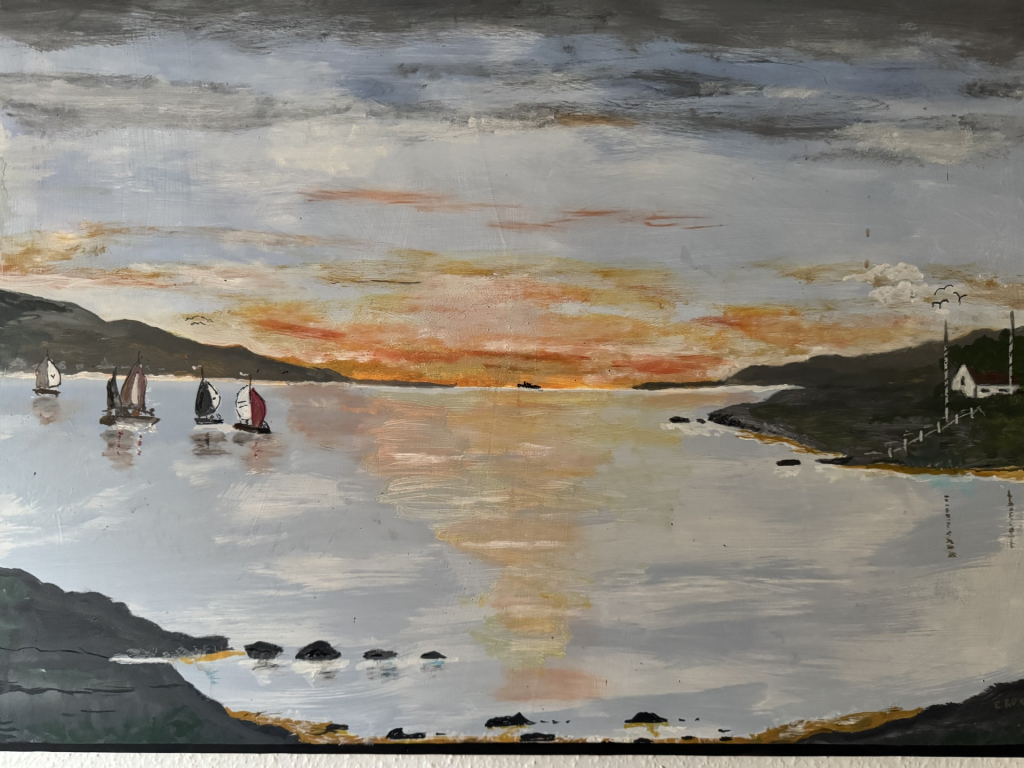 (c) Joe Brown, 2026
Do join me next week for my final Showcase!
*****
Issue 28, featuring author and historian Alison Weir is out now. Issue 29 is due out Monday 22 June and features an interview with travel writer Tharik Hussain. You will be able to find Write On! magazine in libraries and other outlets. Alternatively, all current and previous editions can be found on our magazines page here.

You can hear great new ideas, creative work and writing tips on Write On! Audio. Find us on all major podcast platforms, including Apple and Google Podcasts and Spotify. Type Pen to Print into your browser and look for our logo, or find us on Podcasters.Spotify.com.
*****
If you or someone you know has been affected by issues covered in our pages, please see the relevant link below for information, advice and support: https://pentoprint.org/about/advice-support/