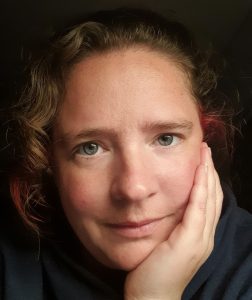
By Sarah Frideswide
 Welcome to Thursday Connectors for the final quarter of the year. Our theme is ‘fractured’. As a poet, and someone with Complex-PTSD, I am particularly interested in how we as people relate to objects and the memories they contain. Found objects have the power to reveal parts of ourselves we’d forgotten or never knew were there. Memories can be buried with an object, only to surface vividly when the object re-appears, and then we wonder how on earth we could have forgotten. We can inherit objects and the memories that go with them and those inherited memories can live in our bodies as though they were a part of our own lived experience.
It seems I’m not alone in my fascination with fractured memories. I’ve been delighted by the depth and vulnerability of what writers have shared in their pieces and amazed at the variety of perspectives they’ve brought to the theme. At the same time, these pieces all speak to each other and, while there is pain here, there is also beauty, both in the pieces individually and in the way they come together and dance around each other. Many fragments can make a whole and, when they do, it is all the more beautiful for having rivers of gold in the cracks.
First, a poem by Khayelihle Benghu , showing what it means to carry the fracture of a country and someone else’s memories inside your own body so that you are always divided, but how that same visceral sense can be the unexpected vehicle of healing and resolution.
The Country Inside My Body
There is a country inside my body that was divided before I arrived.
Its borders run beneath my ribs and its villages sleep in my blood.
Somewhere behind my heart, a road has been cut in two.
My grandmother remembers it whole.
She remembers the fig tree before anyone called the land by another name.
She remembers bread cooling on a windowsill,
And children running barefoot through dust,
the evening call of someone coming home.
But now she carries a suitcase filled with names, not clothes. Names.
She has folded them carefully between old photographs
and the keys to a house that no longer has a door.
“Take these,” she tells me. I ask where I should keep them.
She touches my chest. “Here.”
At night I hear borders being drawn inside me, the hard sound of boots,
a gate closing, a mother counting children in the dark.
I have learned that a map can be made of absence.
A missing brother, a demolished room, a school with no children.
Even a photograph carried through three winters until the face begins to fade.
For years I tried to become one country, I built walls.
Learned the language of every checkpoint.
Changed my name when the guards asked who I belonged to.
Still, something in me refused the border, something ancient.
Something that remembered when the earth did not need permission to be touched.
Now I understand, I am not the country after the war.
I am the map before the borders,
I am the road my grandmother remembers.
The fig tree before the fence, the house before the soldiers.
The child before the checkpoint.
And every scar is a road back not to a country,
but to the people who were told they no longer belonged.
(c) Khayelihle Benghu, 2026
Connect with Khayelihle on Instagram: @KhayelihleBenghu
*****
Next, a story by Paula Widdop and she, too, explores division of the self and body. I love the symmetry in the undoing, unzipping of a pencil case, which simultaneously undoes her.
A Word With Ridges On It
The buyers wanted the loft cleared, which my brother treated as a personal challenge. He’d brought a tape measure and was applying it to things that did not require measuring: the airing cupboard and, at one point, his own head.
“Fifty-eight centimetres,” he said. “Is that normal?”
Normal. A word with ridges on it.
I was up the ladder, a torch between my teeth. Behind the water tank was a Morrisons bag. Inside it, a dirty brown pencil case, its zip split at one end. I had not lived in that house for 35 years, and the thing that remained was the thing that could still undo me.
The pencil had been chewed almost to its metal collar, though only on the left side – the side I still chew. Its rubber was worn concave. It had done an enormous amount of work, though I could not have said on what. The compass point was blunted from being dragged along the wall outside the physics lab. That was what boys did. I had been thorough in my apprenticeship. I did it as you speak a language learned only from books.
The ruler bore my name in Dymo tape. Not my name: the ersatz one. White letters punched into red plastic, one by one – the wheel turned, the handle squeezed. I’d asked for it one Christmas and received it and so, in some sense, had authored my own stageplay.
Over the name lay a white oblong of Tipp-Ex.
I’d gone at it with the little brush, then gone at it again, thick at the edges, as children do when they believe more will make a thing disappear. Tipp-Ex does not take to plastic. Over the decades it had cracked and flaked away, leaving the letters beneath perfectly legible. A child alone, attempting to rub herself out with the blunt instruments of stationery – failing, returning the ruler to its case, then going down to tea.
I did not finish the job. I want that on record.
Inside the case, in biro, was one name: Teresa. Written once, then traced over, so that the T sat deeper than the rest. No heart. No box around it. Nothing to suggest a joke – the sort of insurance you might add if you expected to be questioned.
She had a brace. She left in the third year. For four years, sitting two desks away, I never said a word to her. People will tell you what a name like that means, and they won’t be wrong. But I couldn’t have said whether I wanted Teresa beside me, or wanted her coat around my shoulders, wanted to be mistaken for myself.
“Anything worth keeping?” my brother shouted.
I said no.
He said he’d found a bag of photographs.
“No,” I repeated, before he could open it.
I put the pencil case in my coat pocket. Somewhere around Oxford, I remembered Teresa’s surname. I turned to the window before the tear could belong to anyone else.
(c) Paula Widdop, 2026
*****
Following on from this, Destiny Hankerson looks at curation: how and why we keep things; the collections of everyday objects that build up in our lives.
Curation: A Story Worth Telling
Lately, I’ve been reading a book on curating items and instruments from rock ‘n’ roll history and how objects from the past can tell a story. It made me think about how we curate our identities through our own special artefacts, souvenirs, or memorabilia.
In a way, we create ourselves through the things we care about. Some people are known for building huge collections around a passion or interest, such as people who collect rare watches, cartoons, comic books and so much more. We curate our memories through collecting special moments in scrapbooks and photo albums. And in our modern times, some of our curating even takes place on the internet, with blogs and online sites chronicling our interests, experiences and the things that matter to us.
The act of curating often seems like a special activity, reserved for professionals who work in museums. But if you look closely, you start to see how we curate things in our everyday lives, too. In our culture, we may value certain objects and rituals, building our identities through them. One example is the tradition of putting a star on the Christmas tree, to represent celebration and the Star of Bethlehem. Another is the Afro, a style that connects with African heritage and the pride Black people take in their natural hair.
When I read about how the Rock & Roll Hall Of Fame went on many adventures to gather the treasures of rock legends, I was most fascinated by how the objects told a story. The curators searched for the things that truly mattered: the guitars that were actually played on stage, real lyrics scrawled on paper, even letters from the musicians to their parents (sometimes from before they became rock stars). The history of the artefact, and the potential story it could tell, often mattered more than just the monetary worth of it.
In the same way, we tend to collect and keep things that may not necessarily be meaningful to others, but have a special story for us.
Maybe you keep your old collection of fairy tales because your mother read it to you as a child, and you have lovely memories connected with that. Or you hold onto an old, scratched vinyl record because it was passed down to you by your grandfather. Whatever it is, we curate our favourite things because they touch us and tell a story we don’t want to forget.
(c) Destiny Hankerson, 2026
*****
Finally, a poem by Angela Marshall, in which she examines the nature of memory itself. I was captured by the imagery she uses to make the invisible visible.
Trauma
Threads of memories,
fragile as paper butterflies,
yet the strength
of ropes that bind
as their tiny wing flaps
change the world.
Fragments of yesterday,
intertwined with today,
Sewn together
with invisible thread.
Leaving visible scars
in its wake.
The past confused
with the present.
A kaleidoscope
of darkness,
broken hearts
and shattered dreams.
Knotted and tied.
Tangled.
Flashes of a life
lived in fear.
Traumatised.
Existing. In pain.
No pause or break.
Just surviving.
Day after day.
Trapped in the
tangle of trauma.
(c) Angela Marshall, 2026
*****
Connect with Sarah on Instagram: @sarahfrideswide
*****
Issue 30, featuring author Gillian McAllister is out now. You will be able to find it in libraries and other outlets. Alternatively, all current and previous editions can be found on our magazines page here.
You can hear great new ideas, creative work and writing tips on Write On! Audio. Find us on all major podcast platforms, including Apple and Google Podcasts and Spotify. Type Pen to Print into your browser and look for our logo, or find us on Podcasters.Spotify.com.
*****
If you or someone you know has been affected by issues covered in our pages, please see the relevant link below for information, advice and support: pentoprint.org/about/advice-support


