Nick Burdett interviews Tharik Hussain
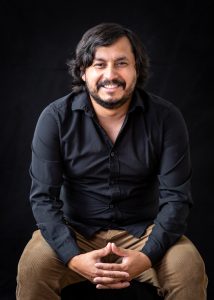 Tharik Hussain is an award-winning author, historian and journalist based in the UK, specialising in global Muslim heritage and culture. He has written for The Guardian, National Geographic Traveller and Al Jazeera and produced the award-winning BBC radio programme America’s Mosques. In 2019, he also created Britain’s first self-guided Muslim Heritage Trail in Surrey. For over 1,400 years, Muslims have been an integral part of Europe’s story. Yet their contributions to the continent’s development and history have often been pushed to the margins or erased altogether. Through books such as Minarets In The Mountains and his most recent, Muslim Europe, Tharik uses travel encounters and lived experience to bring these overlooked histories back into view.
Though non-religious, as an amateur historian and fiction writer, I’m deeply drawn to work that explores place, identity and cultural memory; perhaps that’s why I find Tharik’s approach so compelling. His first-hand encounters feel reminiscent of an older tradition of storytelling. By surfacing hidden histories and forgotten communities, he turns superficially familiar places into much deeper landscapes of memory, movement and cultural exchange.
When he joins me on Zoom, his voice is already familiar. His self-narrated audiobook, Muslim Europe, has been my constant companion and I’m eager to learn more about the journeys, research and personal perspectives that shaped it.
He wastes little time in sharing what he sees as key to his work.
“Proper history writing can be intimidating. I want it to be accessible. Because of the type of history I am revealing here – history people didn’t know existed – this is really important.”
Muslim Europe isn’t written in a conventional historical style. There aren’t vast tracts of fact-filled walls of prose. Faced with histories many readers may never previously have encountered, Tharik deliberately avoids dense academic writing in favour of something more immersive, bringing the past to life through travel writing, geography, personal encounter and story. As a European Muslim himself, he’s uniquely placed to navigate this topic and tells me he was adamant with his publisher that the book should include “glimpses of memoir” – grounding the narrative in personal encounter as much as research.
Tharik is sceptical of the idea of complete historical objectivity and believes transparency about perspective creates a more honest relationship with the reader. His presence within the book is not an interruption to the history, but part of the method itself.
“Having myself visible in there as a Muslim European was important and something the audience would actually appreciate.”
By placing himself physically within the journey, Tharik allows readers to follow him through places, conversations and moments of worship. Elements of memoir, geography and lived experience begin to work together, creating a book that becomes more than the sum of its parts.
That’s not to say academic rigour doesn’t underpin the work. Coming from an academic background, Tharik understands the demands of traditional historical scholarship. By combining that research with a spirit of adventure, he creates something that not only informs readers, but immerses them in stories they won’t have come across before.
To Tharik, the travel-writing element becomes a way of investigating history through movement, observation and encounter. Mosques, churches that were once mosques and other surviving physical structures become an undeniable form of evidence in themselves, carrying both him and the reader across landscapes shaped by centuries of cultural exchange. As the narrative moves through Cyprus, Malta and Spain, the contemporary voices he encounters become just as important as the historical record.
“Those conversations are very important for me because they help to contextualise what that history means to people today.”
A passing observation or casual encounter suddenly reveals the continuing presence of histories many people assume belong entirely to the past, while the journeys themselves continue to become a process of discovery for Tharik too.
“I’m in the Alhambra and bump into Meena, who tells me the iconography reminds her of Bollywood. I tell her what it’s really about. This is a wonderfully organic moment, showing the core thread I wanted to get across to the reader.”
I point out the book also reads like fiction. The pacing and the character-driven focus give the reader an easy entry and I tell him that the immediacy of his dialogue has kept me engaged throughout.
Tharik nods enthusiastically, clearly pleased the book had this effect. He explains how some of the most memorable moments emerge unexpectedly: chance encounters in cafés beside 1,000-year-old buildings, passing conversations or small personal details that suddenly illuminate the wider historical thread. These scenes entertain, but they are also carefully constructed acts of what feels like ‘stealth education,’ history absorbed almost accidentally through story, humour and encounter. “Of course, they don’t realise I’m still teaching them history, you know, in an underhand way.”
He explains this is something he has consciously refined over time, particularly following feedback from the various prizes for which his work has been longlisted and shortlisted. That ‘lightness of touch,’ as many have described it, is something he sees as central to the way he writes.
When I ask about the accuracy of the dialogue, he shares more about his process. Years spent writing travel guides have given him tried-and-tested methods for collecting and reconstructing conversations. If an encounter unfolds naturally, pulling out a phone to record it would, as he puts it, “completely kill the moment,” so, instead, he makes detailed notes shortly afterwards.
More formal interviews, however, are recorded in full and transcribed verbatim. Accuracy clearly matters deeply to him.
“I’m trying to represent the conversation as authentically as possible and where I can’t explicitly remember if they said something, I will then write it down as something that I’m presenting to the conversation.”
Yet beneath that lightness of touch sits a serious commitment to truth and accuracy. This, Tharik explains, is an essential part of writing history. Regardless of the book’s more immersive style, the reader still needs to trust that what they are being shown is grounded in rigorous research and presented with integrity. Tharik’s ‘heavy research’ before going away underpins everything.
“For example, I spent a year in the British Library, reading manuscripts, other historical books… creating an entire body of work.”
He goes on to explain that this was why his publisher trusted him to write history. His methodology is robust, but he has the skill to present it in a digestible way.
This newer way of telling history is important in getting the stories out to a wider audience and William Dalrymple’s travel writing has been a key inspiration behind Tharik’s direction in Muslim Europe.
“I believe in taking the complex, breaking it down and making it palatable to the everyday reader.”
As our conversation starts drawing to a close, it becomes clear Tharik’s enthusiasm is as much about sharing these histories as uncovering them. He speaks with genuine excitement about bringing people into contact with the places he has researched and travelled through, spaces readers may never have viewed in this way before. Sadly, though, the space in the book is finite, so not every detail can make it in.
“You’re so keen to educate people about something they don’t know, you want to tell them everything!”
This is a natural opening to find out more about his process. Tharik tells me his initial copy was three times the required length and had to be edited down to maintain the narrative flow and keep the important parts. Overwriting and then cutting back, he explains, has become central to his creative process. By including “the most enticing and fascinating parts,” he trusts the reader will feel compelled to dig a bit deeper for themselves. As one of his editors once told him, if history is presented in a way that truly connects with people, readers will continue the journey themselves. For Tharik, the narrative is not the end point, but the doorway in.
I realise that, in many ways, he’s become the inside man: borrowing from his Muslim identity and perspective, while the travel element allows him to guide non-Muslim readers and anyone unfamiliar with these histories, through encounters across time and space.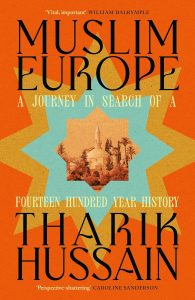
Though Tharik knows even a writer with his energy can’t fully contain 1,400 years of history within a single book, Muslim Europe fills an important gap and I’m already looking forward to his next projects: Muslim Britain And Ireland and a travel guide to Venice.
Throughout our conversation, I have become increasingly aware that readers like me are exactly who he has in mind: “When I’m writing, I’m essentially speaking to people like you, Nick… people who are interested in history, but completely oblivious to a wider, truer history.”
As I write this, I realise what’s lingered is not the histories themselves, but my encounter with Tharik’s way of moving through the world: the curiosity with which he approaches places, people and stories and his ability to lead us towards the hidden histories embedded within places we thought we already knew.
*****
Issue 29 of Write On! is out now. Featuring an interview with travel author Tharik Hussain the theme is ‘ Borrowed’ and you can read it online here. Find it in libraries and other outlets. You can find previous editions of our magazines here.

You can hear great new ideas, creative work and writing tips on Write On! Audio. Find us on all major podcast platforms, including Apple and Google Podcasts and Spotify. Type Pen to Print into your browser and look for our logo, or find us on Podcasters.Spotify.com.
*****
If you or someone you know has been affected by issues covered in our pages, please see the relevant link below for information, advice and support: https://pentoprint.org/about/advice-support/