Showcase: Loaned Some + Let Me Borrow A Little More + Facing The Singularity Of AI
- 20 May 2026
- News, WriteOn Showcase
Edited by Vrushali Khadilkar

Welcome to the third Showcase of the month!
Recently, the calendar pinged to tell me it was ‘World Laughter Day’ and I went looking for some comedy specials and funny sketches available on the internet for free. We borrow so many things from internet strangers to boost our dopamine, don’t we? Just like that, I boosted my serotonin and was cheered for my day ahead.
Today’s submissions ask what it means to live within what is not fully ours and how, even then, we take meaning from it. It feels deeply in tune with our ongoing theme of ‘Borrowed.’ Read on!
****
Firstly, we have Shane, who writes wittily about the book he borrowed from the library and is surprised by a stray strand of hair inside. A bookmark, maybe?
Loaned Some
There’s a hair in my library book
but l won’t send it back
as though it were a bowl of soup.
It’s brown, just like mine, meaning the last borrower and I share more than a taste for European literature.
I leave it lodged in the dust jacket
and smile a little nervously
at the opening page facing me.
Hard to know exactly
whether the book realizes
that it seems to attract a type.
© Shane Schick, 2026
Connect with Shane on X: @ShaneSchick
*****
In a mythologically-woven narrative, Lesley’s protagonist finds herself among powerful beings, voicing a desire to borrow more time. Tick-Tock!
Let Me Borrow A Little More
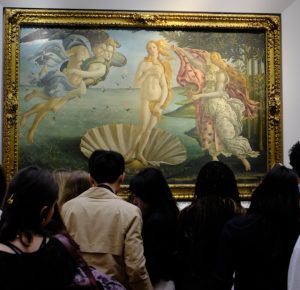
Florence sat before the painting and witnessed the birth of the goddess, Venus: her shy posture, new to the world, surrounded by Spring flowers and welcomed by one of the Horae, Thallo, the goddess of rebirth and the protector of youth.
Florence had to stretch her back and tip her head to the side as people walked in front of her blocking her view. Sadly, she realised she was invisible in this wheeled chair. Sinking with rounded shoulders, Florence remembered how difficult it had been to persuade her family how determined she was to travel to Italy.
Repeatedly, she’d told them how important it was for her to go. It had been her dream since being a teenager, when she studied art at school.
“What if some ‘thing’ happens while you are away?” they cried with concern and troubled eyes. Florence shrugged at the unnamed ‘thing,’ the silence consuming the room. She could only reply, “I’m living on borrowed time. Let me borrow a little more to fulfil my dream.”
The coffee cups rattled on the table, chairs scraped across the tiled floor. They pleaded tearfully, but Florence remained resolute.
Watching her loved ones leave her, she felt selfish. “Damn it! Time is selfish,” she exclaimed to her empty cup. “Don’t betray me now. I’m only 45!” Unlike the goddess Venus, Florence was well aware of mortality.
So, she’d travelled across Europe to meet the painted goddess. For a moment, she wanted to live in a world where there were only new beginnings and to feel the joy of youth through the goddess Thallo. She wished to be noticed down here near the floor and carried on a gentle tide to a strange shore, where she would be festooned with the golden buds of Spring, renewing her tired body.
Anything, anything, rather than the days and weeks spent in hospital beds, with treatments seeping her time away.
Florence straightened her shoulders. She could see clearly now. The crowd had moved on to the next painting, their voices a retreating hum. Alone, Florence felt a dreamlike quality in the stillness of the gallery.
A dream it must be, as she found herself rising from her chair and taking the hand of a youthful woman. Pale and radiant, she was smiling gently and surrounded by the fragrance of magnolia and wisteria, their petals lightly touching her hair and shoulders. The woman spoke softly and said to Florence: “There is no need to borrow time. I give you my gift of peace and a new day.”
© Lesley Anne Armour, 2026
Connect with Lesley on Instagram: @seasand_lesleyanne
*****
Here, Vic imagines a reality where labour shifts and time itself is restructured; where we might borrow ease and stability through new systems by adapting to a universal basic income while renegotiating purpose.
Facing The Singularity Of AI
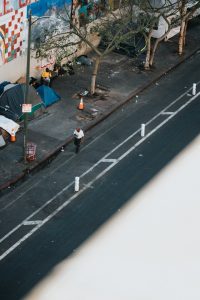
London is reported as the homelessness capital of Europe. Over 13,000 are sleeping rough on its streets and a further 170,000 are in temporary accommodation provided by local councils, but the problem has hardly begun.
The reasons for homelessness are many: financial, mental illness, drug addiction, family relationship problems, etc. All are familiar and have increased recently, but job-loss is becoming the most prevalent and we could soon be facing an increase that will be devastating to our way of life if Artificial General Intelligence, AGI, is employed as much as is expected.
Pretty well all mundane intellectual labour carried out at a desk could be taken over by AGI and to a large extent will be. Unemployment will rise dramatically and there will be no replacement jobs. Rents will be unpaid and mortgage repayments will also be impossible to meet. However, this is not just a problem facing London. Every country in Europe and North America will face the same problem. This is not speculation, but a fact that will be with us very soon and far sooner than has previously been predicted. The question of whether humanity will be destroyed by AI is not one of ‘Terminators’ and evil machines. By developing and using AI, humanity is in the process of making itself redundant. A recent study by the Massachusetts Institute Of Technology, MIT, has shown that the regular use of AI to carry out tasks is dulling people’s ability to reason rationally.
Elon Musk has talked about work becoming an option. I think he’s wrong and vastly underestimates the situation. Work will not be available as an option. He is busily constructing humanoid robots he calls Optimus, which he plans to produce in millions to be placed in every home as a home-help. Who, I wonder, is going to be able to afford one of these robots? Other Optimus robots will be employed in factories building cars and other products, including more Optimus robots: the nightmare scenario of machines creating duplicates of themselves and writing updates to their own software. Today, between 30 to 40 per cent of software is already written by AI. Where is the money going to come from to pay for these cheaply made products and robots and who will reap the profits from selling them? Developers of AI are busily creating a problem they are completely ignoring, i.e. mass unemployment followed by homelessness. Why are the main AI development companies racing to create AGI? A complex question to answer but basically, the company that gets it first will dominate the world in every way. To have been the person or company who achieves that position will create a god-like feeling of having initiated a new form of life.
We are fast becoming a divided society between those who have and those who do not. Geofrey Hinton, the godfather of AI, has said that plumbers and other skilled artisans will be wanted far more in the future because robots do not have the manual dexterity and ability to do such complex work. A white-collar worker with an expensive university education will, however, be easy to replace. The divisions in society won’t just be between the very rich and the poor, but will also be between those with the right kind of skills and those who made the wrong choice when leaving school. A university education will become a luxury for the gifted who intend to aim high. An ordinary and expensive BA will be worthless and almost impossible to pay back.
In the midst of all this, we have the situation where students are using AI GPT to complete course work. Many universities are campaigning to have future exams online, making answering exam questions possible using GPT. Added to this is the prospect of professors using GPT to check exam answers that have been provided by GPT. The result? Worthless degrees that will have to be paid for by their unemployable, ignorant holders. Indiscriminate use of AI GPT could gradually destroy the education system and put the progress of humanity back generations. That is how I see the situation we have today, at least. Tomorrow we shall have Artificial General Intelligence, AGI, which will be capable of anything a human can do. There will be no incentive to employ flesh and blood workers, when AGI in the form of computers or robots can do the same work faster, cheaper and better than humans. It has been estimated that up to 80 per cent of humanity will be redundant.
Reading the popular news media and following the political news has yet to show any suggestion that governments are taking this threat seriously, if at all. There are currently far too many wars and disruptions in the balance of world trade and power to have time for considering the dangers of AI. Dealing with this problem will have to transcend political affiliations; it will be an existential one.
There will, or ought to be, an excess of production from factories producing goods cheaply, but no matter how cheap they become, if there is no money in circulation to buy them, the whole exercise is pointless.
Money is the lubricant to a well-oiled society. If it cannot be earned, then it must be provided in some other way and the most obvious is through Universal Income: an income that will not just raise people above the poverty line but make life possible. Many who have work might think this unfair, though they would be the lucky ones. Others, for political and other reasons, will think it will encourage laziness and exploitation. Of course it will. All efforts to govern sensibly are always exploited; it’s what some people do, but they will be a minority. The majority will be relieved and be able to resume life and help restore civilisation, which will otherwise be in danger of collapsing into chaos and anarchy. An even bigger question, however, will be what will be the reason for living if creativity is removed from existence? Painting, writing, playing music and writing music are all attractive because they are difficult. The human brain needs the challenge.
If we want to survive mentally, we should reject using AI in any creative way.
Where will the money come from to provide financial security in this utopia? Since there will be little labour involved in producing the cheap products, I suggest that half the ownership, i.e. profits, of any company employing more than 50 per cent AI workers shall be taken over by the state to provide Universal Income. The spin-off effect of such a system will be a reduction in mental illness, an improvement in general health and fewer people living rough on the streets. And for owners of these factories, the relinquished half of production will also provide the means for selling the other half.
I am, of course, ignoring the fact that not everybody has the mental capacity to be creative. Drugs, alcohol and myriad other distractions will proliferate.
We’re about to face what has long been called the Singularity of AI. Everyone involved in the development of AI has warned of this but been unable to explain it, because singularity is the point beyond which one cannot predict the outcome. Life will never be the same after AGI and certainly not after Artificial Super Intelligence, ASI. Mankind will have to forget political rivalries and get used to being subordinate to a new species with greater intelligence. And if you want to know how that feels, says Geofrey Hinton, ask a chicken.
© Vic Howard, 2026
*****
I hope these pieces stay with you as we come to the end of this week’s Showcase. Wishing you a lovely week!
*****
Issue 28, featuring author and historian Alison Weir is out now. You will be able to find it in libraries and other outlets. Alternatively, all current and previous editions can be found on our magazines page here.

You can hear great new ideas, creative work and writing tips on Write On! Audio. Find us on all major podcast platforms, including Apple and Google Podcasts and Spotify. Type Pen to Print into your browser and look for our logo, or find us on Podcasters.Spotify.com.
*****
If you or someone you know has been affected by issues covered in our pages, please see the relevant link below for information, advice and support: https://pentoprint.org/about/advice-support/