Showcase: Music + Dark Blackberry Wine + The Ballad Borrower + I’ll Tell My Ma
- 10 June 2026
- News, WriteOn Showcase
Edited by Gloria Maloney
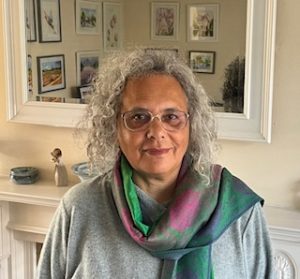
Hello, and welcome to week two of my June Showcase!
The pieces I’ve chosen to share with you focus on the theme ‘Borrowing’ from music.
Playing a musical instrument or singing releases endorphins which gives as a healthy dose of mental wellbeing, reducing stress and anxiety, leaving us full of positivity. Community choirs offer social cohesion and collaboration, bringing people together, which is vital in this era of a digital world and AI.
I’ve chosen pieces written by my friends Helen and Brian from my Toot Hill Folk Club.
*****
First, Helen beautifully shows us how she has developed and shaped music into her own voice.
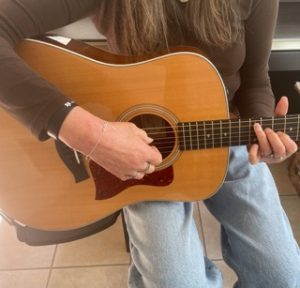
I was blessed. I grew up in the sixties, surrounded by beautiful, contemporary music. When I was 15 or 16 my father’s old guitar was discovered in the attic. To be honest, it was far from great; basic and battered, it twanged rather than sang, but he allowed me to use it and I did. All through a long hot summer, I made it mine until I bought my own.
In those days, we friends jammed together, swapped chords, learned from each other, tackling just what we needed to in order to play each new song that appealed. It was a fertile environment, and all we required to get started was a key and three chords; the rest grew from shared experience.
There were so many wonderful artists to listen to and to learn from: Joan Baez, Janis Joplin, Joni Mitchell, Melanie Safka, Carol King, Carly Simon, Sandy Denny, Maddy Prior… We borrowed from their repertoires and thus we honed our skills. For a long time, it seemed like enough. These women poured their hearts out in their lyrics; they spoke to us and we echoed their voices and their sentiments. I rapidly learned to play finger style rather than mere chords. Nuance, refinement and ways of ‘owning’ something, even if someone else had written it, began to be important. Important, but not enough, not sufficient, because it is impossible to truly own something that was originally created by someone else…
I had always written: prose and poetry were part of my lifeblood. Personal expression is a vital force. I admired much that I found in the lyrics written by the aforementioned ladies. Often, the words were simple, but the effect so powerful. A few examples:
Melanie’s haunting images against the horror of war:
We were so close, there was no room/We bled inside each other’s wounds…
Joan Baez on an achingly unrequited love:
Our breath comes out white clouds/Mingles and hangs in the air
Speaking strictly for me/We both could have died then and there.
Janis Joplin, from One Good Man:
Some girls they want to collect their men/They wear ‘em like notches on a gun.
Carole King reflecting on human experience:
My life has been a tapestry of rich and royal hue/An everlasting vision of the ever-changing view.
Clearly, I could quote from every influence I listed above and more. The most important feature here is that the writing in every case is honest, born of experience and reflection. It was Sandy Denny who wrote:
Before the winter fire, I will still be dreaming/ I have no thought of time/For who knows where the time goes?
t was time for me to grasp what I’d learned from others and to grow. Borrowing was no longer as satisfying, and authentic expression became the goal.
Even now, when I write a new song, it essentially begins its life as a poem. I know many musicians who can begin with melody and move on from there, but I’m not one of them. Principally a wordsmith, I jot down lyrics as they arrive, hone and rearrange, delete and replace and tweak them until I’m satisfied. Even then, a revisit will often call for modification. For me, arriving at a perfect expression of what I want to say is like a niggling itch until the process is complete: if it’s not quite right, it just won’t do! Thank God (and I mean that sincerely) for a pencil and a good eraser, or for the wonder of a tablet! It’s so good to be able to endlessly revise, and even better to be able to catch and entrap the ghost of an idea in order to further shape it at leisure.
Jottings matter! They are vitally important, for when fully worked through they become something far more precious. Thus, songs begin to be born, to find their unique melodies, to coalesce, and to take to the air…
© Helen Gaize, 2026
Helen has shared this vivid beautiful song, painting a picture of lush countryside bursting with the fullness of fruit for our enjoyment, borrowing from nature and acknowledging the gifts she gives to us.
Dark Blackberry Wine – A Song

The grasses of the orchard exhale scrumpy in the heat,
So many are the apples on the ground
And blackberries, like dark, red blood are dripping from the bush –
Winking jewels that are begging to be found.
Refrain:
And these days upon the pathways are the richest of our times
And we’ll drink to them with cider and with dark… dark blackberry wine.
The road extends past waterways and curves beside the lake;
The sky is both above me and below.
Mirrored in the stillness of the surface and its gleam,
The white, the azure and the golden glow.
The road winds past the grainfields, through the woodlands, over crags:
The air is ever sweeter here and clean,
The placid sheep good company: they leave me to my thoughts
And the lullabies of bees amidst the green.
Breathe the best of wanderlust; weep for beauty’s sake,
Taste the wild, be driven in the storm.
Ride the winds as seasons spin; the path is ours to take,
And drink of both the apple and the thorn.
© Helen Gaize, 2026
*****
Next, Brian tells us about his heritage, borrowing songs from his ancestors and the pleasure he receives in passing these on to his family, keeping the tradition going.
The Ballad Borrower
For as long as I can remember, I’ve had a keen interest in the singing of songs and of the people who sing them: be they the ballads of Old Ireland, rich in the sentiment of emigration, lost love, rebellion, shanties and songs of the sea, or songs that tell a tale. This love probably originates very much from my family’s Irish heritage as fisherfolk and seafarers but is also influenced by the many stories told me by my grandfather, George. George served in the First World War, part of that ‘contemptible little army’ who, in August 1914 as a soldier in the Essex regiment, delayed the Kaiser’s steam roller, during the British army’s retreat from Mons.
Cecil Sharp, a famous collector of folk tunes, sometimes termed the song snatcher, toured Appalachia (eastern states of America), in 1916-1918, collecting songs from the British Isles. The inhabitants of those remote mountains, the Hillbillies who migrated there in the 17th Century, sang versions of the songs handed down from their forefathers through the oral tradition, with little outside influence and providing an interesting window into the past.
I, too, in my own little way have been a borrower of melodies and rhymes, a ‘ballad borrower’ if you please. Over the years, I’ve collected songs that have subsequently become firmly embedded in my own repertoire.
Three Crows
Many songs, such as The Wild Rover and Leaving Of Liverpool, just seem to have been known to me growing up. However, there are others I can recall encountering at a moment in time. The first of these was in the summer of 1980 while working as a camp councillor in Massachusetts New England, teaching outdoor adventure. I had the good fortune to meet up with Jerry from Glasgow. We were kindred spirits enjoying singing and the swapping of tunes. Jerry introduced me to a number of Robbie Burns songs and a children’s song: Three Crows.
Three Crows, for authentic effect, is sung best with a Scots/Glaswegian accent. It has a simple repetitive verse structure making it easy to remember. The song is reputed to date from the 19th Century and is, I understand, still sung in schools in Scotland.
It was a favourite of my children growing up, a regular feature of the long car rides. As a song, it remains ever-popular with the family; my five-year-old grandson George recently singing it at a the Toot Hill January Burn’s Folk Night.
Oh, Fine Drunken Man
I first heard this song in February 1984 while enjoying a weekend’s climbing with two friends in the Langdale Pikes. After a cold day’s scrambling, we retreated to the comfort of the Old Dungeon Ghyll. There, gathered around an open fire, a sing-song began and a young lady with a voice similar to Maddy Prior’s sang a wonderful rendition that stays with me to this day.
The verses, nonsensical in nature, reminded me of Tolkienesque riddles. They describe the incredible sights and tales one drunken man might share with another, after a very heavy evening supping ale. I tried to commit the song to memory but could only remember three verses. In those pre-internet days it proved difficult to track the lyrics down and I resorted to making up two verses of my own, to give the song the respectable length it deserved and the opportunity to sing the rousing chorus a few more times!
I have since discovered other variations of the song and suggestions it dates back to the 16th Century. There is even debate as to whether the song is Scots which, over time, has been Anglicised.
I’ll Tell My Ma
This is a song I only became fond of in 2011. It was originally a skipping song, heard on the back streets of Dublin and Belfast. While cycling the Wild Atlantic way, I was introduced to a unique and beautiful arrangement. I was familiar with the breakneck, foot-stomping tempo in which the great Dubliners performed the song. But one night in a bar in Kilrush, Eamon Bannon from County Down sang a version quite unlike anything else I’d ever heard. He began slowly plucking the chords, before gently introducing the lyrics. These he sang deliberately, elongating each word with the pace gradually increasing until, almost hitting a turbo-charged lung-bursting crescendo, he dramatically paused, finishing with the question: Who is she?
My daughter Clare sings a haunting a capella version of Eamon’s arrangement. It closely mirrors his version but incorporates her own interpretation. In fact, the song has become so popular within the family, my grandsons William and George often sing it with her, when going about the house or at family gatherings.
I’ll Tell My Ma and Oh Fine Drunken Man are firm favourites with the many friends who come along to our folk nights at the Toot Hill village hall on the third Friday of each month. In the case of Oh Fine Drunken Man, additional verses have, over time and often spontaneously, been added. Both offer great opportunity for collaborations and the layering of voices in beautiful harmonisations.
If songs are not sung, they’re soon forgotten. In my own small way, by singing the songs collected over nearly 50 years, I have helped to breathe the breath of exposure into them, keeping them alive for others to share.
(c) Brian Christopher Sainsbury, 2026
Next week, we will be sharing some more lovely pieces on the theme of Borrowed.
*****
Issue 28, featuring author and historian Alison Weir is out now. You will be able to find it in libraries and other outlets. Alternatively, all current and previous editions can be found on our magazines page here.

You can hear great new ideas, creative work and writing tips on Write On! Audio. Find us on all major podcast platforms, including Apple and Google Podcasts and Spotify. Type Pen to Print into your browser and look for our logo, or find us on Podcasters.Spotify.com.
*****
If you or someone you know has been affected by issues covered in our pages, please see the relevant link below for information, advice and support: https://pentoprint.org/about/advice-support/