Nostalgia, Memory And The Messages We Leave Behind
On the drive to Dorchester and the newly opened Jawbone Cafe, I found myself looking again at the ancient landscape around me.
Here in Dorset it’s very difficult to travel far without passing something that reminds us that people have occupied this landscape for thousands of years. Barrows crest hillsides. Henges and earthworks create ripples in fields. Ancient tracks follow ridges that were being walked long before anyone thought about tarmac, road markings or satellite navigation. We see these shapes in the landscape so often that sometimes we stop seeing them. Yet somebody made them. Thousands of years ago, people gathered together, moved earth and stone, buried their dead, marked significant places and permanently altered the landscape.
We may not know their names. We don’t know what they talked about while they were working. We don’t know what made them laugh, who they loved, what they worried about, although by the diligence of archaeologists we can sometimes find what they ate for breakfast. But we do know that they were here. They left their mark. I wrote a short poem about exactly this thought.
Messages From The Past
Stars kiss the earth
of the green and ancient land
Earthworks like ripples
around the maiden stand
Stones and barrows crest
the hills to greet the sun
Landscape whispers tales
of people long since gone
Messages from the past
sent by the hands of men
Monuments by the living
so the dead can walk again
(c) Peter Roe, 2018
*****
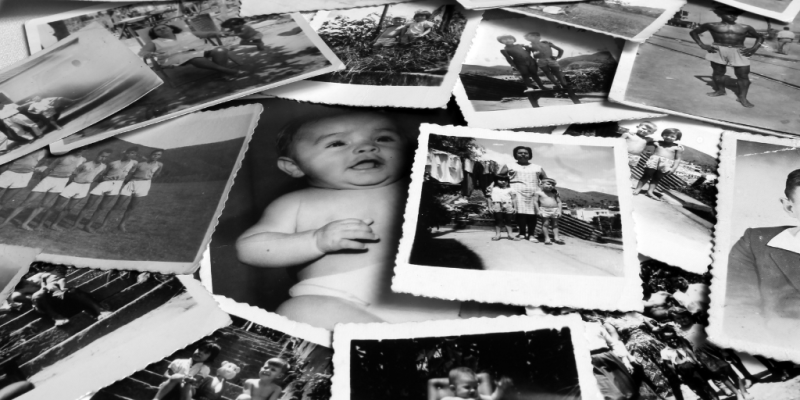
Perhaps humans have always had an extraordinary need to leave something behind. Sometimes we move thousands of tons of earth. Sometimes we raise stones. Sometimes we carve a name into something. We paint pictures, make pots, build houses, plant trees, keep photographs, save letters and write poems.
Perhaps somewhere inside all of those things is the same very simple declaration: “I was here!”
Over the previous weeks, I’ve been thinking about nostalgia as memory. In the first week, we explored the way memory can change with time. In the second, we looked at the things we carry forward with us: songs, stories, traditions, places and objects. This week, I’ve found myself thinking about the other direction. What do we leave behind? What will tell somebody in the future that we were here?
For most of human history, lives disappeared almost completely. Unless someone was wealthy, powerful or considered historically important, there might be little more than a name in a parish record, an entry in a census, a gravestone, or perhaps an object somewhere whose story had become separated from the person who once owned it.
History is partly determined by what happens to survive. Memory is probably much the same.
What we remember is not necessarily what was most important at the time. It might simply be the thing that lodged somewhere in the mind and refused to disappear. That’s why writing matters. A writer can capture one of those apparently insignificant moments and give it another life. William Barnes described his poetry as “Glimpses of life and landscape in Dorset, which often open to my memory and mindsight.”
Thomas Hardy repeatedly returned to objects, buildings and landscapes containing the traces of people who had gone before him.
Old Furniture
I know not how it may be with others
Who sit amid relics of householdry
That date from the days of their mothers’ mothers,
But well I know how it is with me
Continually.
I see the hands of the generations
That owned each shiny familiar thing
In play on its knobs and indentations,
And with its ancient fashioning
Still dallying:
Hands behind hands, growing paler and paler,
As in a mirror a candle-flame
Shows images of itself, each frailer
As it recedes, though the eye may frame
Its shape the same.
On the clock’s dull dial a foggy finger,
Moving to set the minutes right
With tentative touches that lift and linger
In the wont of a moth on a summer night,
Creeps to my sight.
On this old viol, too, fingers are dancing –
As whilom – just over the strings by the nut,
The tip of a bow receding, advancing
In airy quivers, as if it would cut
The plaintive gut.
And I see a face by that box for tinder,
Glowing forth in fits from the dark,
And fading again, as the linten cinder
Kindles to red at the flinty spark,
Or goes out stark.
Well, well. It is best to be up and doing,
The world has no use for one to-day
Who eyes things thus – no aim pursuing!
He should not continue in this stay,
But sink away.
(c) Thomas Hardy, 1917
I find that idea fascinating. An old chair is just an old chair until we know who sat in it. A watch is simply a mechanism until we know whose pocket it occupied. A worn step becomes something else when we realise the hollow in its stone has been created by generations of feet.
Objects can become repositories of human presence. In a workshop at Dorset Museum, one of the participants suggested to me that charity shops are just such places where the ephemera of a life is briefly laid out before re-distribution and re-interpretation.
Sometimes, though, the monument was never intended to be a monument at all. My Write On! Audio Listener contribution, featuring A Field Guide To Wonder, is now live on Spotify. One of the poems included in that collection is Eulogy To An Eco-Warrior.
It remembers Selwyn Footitt, someone I knew during my childhood in Derbyshire. Selwyn walked. He walked everywhere. He knew the names of the plants around him and shared that knowledge. He planted trees along the grass verges as he travelled. At the time, they were simply saplings, young trees. More than half a century later, many of them are still there. The person who planted them has gone, but the trees continue. I wonder whether Selwyn ever thought of them as monuments? Probably not. Yet to me they have become exactly that.
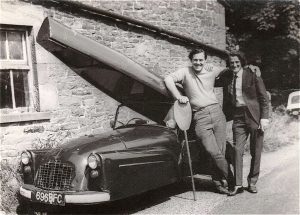 There are also photographs. One shows Selwyn sitting in a rather unlikely paper boat on the water. Another shows my father standing beside a three-wheeler car called ‘Flossie’ with that same boat strapped to its roof. My father had constructed it from paper barrels pinned on a wooden frame and waterproofed with car underseal.
It sounds sufficiently improbable that without the photograph someone might reasonably assume that memory had embellished the story. But there it is. The boat existed. Selwyn sat in it. My father created it. For one brief period of time that strange boat occupied the same world that they did.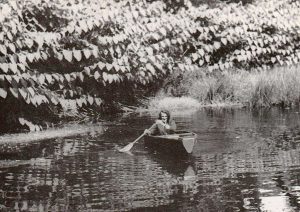
The boat itself is long gone. Selwyn is gone. My father is gone. But the photograph remains. The trees remain. The story remains. Now the memory exists in another form as a poem and as a recording of my voice. Which of those things will last longest? An interesting question.
The ancient people who constructed Dorset’s barrows built in earth and stone and their work has survived for thousands of years. A printed photograph might survive for generations in a box or album. A letter can sit forgotten in a drawer for a century and suddenly become an extraordinary historical document. But what about our modern records? We probably record more of our lives than any generation that has ever existed. Every day, billions of photographs, messages, videos, emails and posts are created. But are we actually leaving more behind? Or are we creating enormous quantities of extraordinarily fragile memory?
A photograph in a shoebox does not require a password. A letter does not stop working because its operating system is no longer supported. A gravestone does not need its subscription renewed.
We may be the most recorded generation in human history, yet perhaps some of our records are more ephemeral than those of our grandparents. That thought made Nicole Brown’s poem Proof Of Life stand out for me.
Proof Of Life
I know his face
through a screen now.
A photograph.
A birthday post.
Enough to know
he is alive.
Not enough to know
if he’s okay.
He grows between
photographs.
The older ones
have both of us.
His arms around me.
Mine around him.
I ask God
to tell him
what I no longer can.
I run my thumb
across his face.
Nothing reaches back.
(c) Nicole Brown, 2026
Connect with Nicole on Instagram @iamnbrownn
There’s something powerful in that final gesture. A thumb moves across a face, but the face is behind glass. That might be the defining differences between old and contemporary ephemera.
When I hold one of those photographs of my father, I am holding an object that existed within his lifetime. Light reflected from a real physical moment was captured onto film and eventually turned into an object I can still hold.
Nicole’s speaker touches a screen. The gesture is almost identical. The relationship with the object is completely different. Both are attempts to cross the distance between now and then, presence and absence.
Perhaps that is what nostalgia really does. It attempts to touch something that cannot touch us back.
*****
Another submission this month takes a different route through family memory. Allan Lochhead’s Images Of A Family compresses decades into flashes; courtship, marriage, children, illness, holidays, letters, village life, accidents, concerts and childhood games.
We don’t experience a life as a continuous narrative when we look backwards. We remember fragments.
Images Of A Family
The guns fall silent over a World greyed by War.
Under a new sun, new life stirs and colours brighten again.
Two, young people meet, a splash of colour. Auburn hair and a ginger tweed suit and bright blue shirt.
A walk, a dance, a concert.
That storm at Knole.
Love in the rain.
A wedding.
A blur of ecstasy
St Mary’s or was it St Nicholas.
New hope and vigour.
Anticipations and best intentions for a happy fruitful life.
Two rooms, two babies, a fledgling family.
A cold foggy night in February arrives the third.
Anxious times.
The startling effect of the telephone’s ring.
A premature fourth.
Relief at a weighty fifth.
Brood complete.
Times of trouble, Mum in hospital, Dad in Australia.
Long awaited letters thumping Joyously on the door mat.
Separation and fatigue.
Struggle and survive.
Holidays, picnics and bracken.
Pastel blue skies and Atlantic wind whipping through
tousled curly hair and thick knitted jumpers.
Daisy chains and Thermos tea.
The Needles explained.
A procession of Dad, five young ones, Mum at the rear,
cajoling and rounding up.
Dad striding out, extolling the velocity of sound to the wind.
All walking the path together.
Tents in gardens,
tin-can telephones, smoke signals
summoning a pow-wow.
The children’s paradise, the magical world.
Games of schools, weddings and dressing up.
A cacophony of happy sounds and laughter.
Childhood traumas, bicycles, berries, garden forks, scalding tea, wounded knee.
Mum come quickly!
A and E.
A village life, full of church and friends and fetes and concerts.
An idyll perhaps.
The cosy friendly wood of the Village Hall and the stubborn chairs set in rows.
A pool of yellow door light signals another show.
David and Francis as Squaw and Hatter.
Glynis in Persephorse.
Puritan Christine and Howard as Oliver Twist.
A blur of snapshots.
A happy, happy life.
How rare.
What a cliché some would say.
But not here.
Look around you.
What love!
What happy children!
What a legacy!
All walking the path together.
(c) Allan Lochhead, 2026
Connect with Allan on Instagram: @allanlochhead
A blur of snapshots… That phrase seems remarkably accurate. Memory rarely gives us the whole film. It gives us still images. In Allan’s piece, those fragments eventually accumulate into something much greater. Perhaps that is how most of us survive. Not through statues. Not through biographies. Not through entries in history books.
We survive for a while in the memories of other people. We become the story someone tells about the things we once did. The recipe somebody still cooks. The expression somebody inherited. The photograph that nobody quite knows the date of. The tree somebody planted. The poem someone wrote because something mattered enough not to be forgotten.
*****
Again, Althea Dawn’s The Undone Story approaches this from another direction.
The Undone Story
Sitting out on the balcony
reading your old messages
repeatedly
My eyes wander
to the skylight somehow
Seeking the smile I used to see
and remembering the hands
I used to hold
through the night
Tell me a story
any story
About your laughter
without my voice beside you
How can you keep walking
under the sun
with the scars of flame
that I left on you?
Is there any way
I can undo the story?
The dust on my journal is thick
The blank pages have turned yellow
none but the shadow of our unwritten poem
The words were scattered
leaving the unfinished pieces
Untouched
(c) Althea Dawn, 2026
Connect with Althea on X: @altheasdawning or via their website: www.bubblesofreverie.com
I like the paradox within this piece. Even the blank pages have aged. Nothing was written on them, yet time has still left evidence of itself. Perhaps absence can become a form of record too. The story we did not finish. The letter we did not send. The photograph we didn’t take. The conversation we intended to have tomorrow. All leave spaces around which memory grows.
*****
Earlier this month, I suggested that nostalgia is not necessarily a desire to return to the past. I’m increasingly convinced that it is also connected with our awareness of transience. Things disappear. People disappear. Places change. Buildings are demolished. Languages change. Customs vanish. Even landscapes change. Against that constant movement we make marks. Some, like a barrow on a Dorset hillside are obvious. Some, like a poem unread in a notebook, are almost invisible and we can’t know which will survive.
Hardy hoped, but he could not know that people would still be reading his work a century after his death. Barnes could not know which fragments of the Dorset he recorded would resonate with readers generations later. The people who raised prehistoric earthworks certainly could not have imagined cars passing them thousands of years later while somebody on their way to work wondered who they had been. Selwyn probably didn’t plant those trees because he expected a poet to write about them 50 years later. Yet here we are. Perhaps that’s one of the extraordinary things about writing. It’s another way of altering the landscape. Not with earth and stone, but with words. A writer makes a mark and sends it forward without knowing who might eventually find it.
So my question to you this week is: What are your messages from the past? What survives in your family? Perhaps there’s something apparently insignificant that means nothing to anyone else but contains an entire world for you. What are you leaving behind?
Turn on the tap. Write it down. One day, your words may become somebody else’s message from the past; you may even be inspired to contribute to the new theme of ‘Fractured’ around these thoughts and ideas. Keep writing, keep remembering and keep leaving your mark.
Next week, we’ll continue to rummage through the wonderfully untidy cupboards of memory to see what else has been hiding there!
*****

You can hear great new ideas, creative work and writing tips on Write On! Audio. Find us on all major podcast platforms, including Apple and Google Podcasts and Spotify. Type Pen to Print into your browser and look for our logo, or find us on Podcasters.Spotify.com.
*****
If you or someone you know has been affected by issues covered in our pages, please see the relevant link below for information, advice and support: https://pentoprint.org/about/advice-support/