Write On! Features: Authorship Of A Violinist by Ruth Palmer
- 18 September 2026
- News, WriteOn Features
I hear you playing to me on your tiny violin. What came first, the plaintive melody or the pain? Can you choose your narrative?
Many violinists don’t know the answer, because they’re born into a situation where they will become violinists. The instrument appears in their hands during the years of nature’s enforced childhood amnesia – before the age of three or four – and when they wake up, ding! a violinist! Where some parents say: Thou shalt be a doctor, and thy brother shall be a lawyer,” in other families there’s no conversation, because the child can’t speak fluently or remember yet. Some children start a bit later and can remember it, but many of the violinists you see on stage today will have started before their recollections, before their own history began.
If you can accept it, it’s an enormous gift; to be given this neuromuscular art and its centuries of flourishing forms that unfold through time in our memory of a concert of flowing nows, its infinite variations on love and drama, its capriciousness, its miraculous connection to an imagined mysterious divine, offering reassurance of meaning, constant challenge, and life-long continuity of purpose. Whatever your mental or emotional state, classical music has got you. Not necessarily financially, nor a guarantee of workplace wellbeing or personal safety even as a child, but it’s one of humanity’s greatest creations, an unimaginably wise companion.
And there you are, a musician with a vocation gifted by the chance of your birth and life circumstances, absorbing into your future art, your education, your future earning potential, your friendship group, the overpowering psychological imprint of your parents and teachers and the management structures of an art world much older and much less woke than your grandparents.
That starting point opens the door to not just your talent and discipline but also admits the burden of any trauma those adults and structures carry with them. If trauma is there, you’ll not only seek out situations that compound it, you will be drawn back to your tiny violin and if your heart is still awake you’ll choose pieces of music that express it. The plaintive melody. Even though this sounds fatefully cruel and simply the perpetuation of suffering, music is not complaint. Great music is identifiable because at the root of it is love, affirmation of life and transformation of suffering through a musical meditative catharsis. No one ever wrote a great piece of music because they hate life. The suffering is not the main event. Love is.
Taking control of your narrative as a performing musician – claiming your authorship – means becoming aware of what you have been expressing so far, and allowing the guidance of that great music to carry you beyond the paradigm of your birth. When you realise that the truth of life’s basis is kind, aware, loving and powerful, and that you are not its side-effect but an integral part of it. That’s when you can choose which story you want to tell. If you’re really engaged, you’ll have expressed yourself in some great tragic works, you’ll have felt the pathos in your fingers as your violin responds with Poe’s molten-golden notes and you’ll have connected to the deep reassuring resonance that rings through classical music, and once you’ve really heard it, you are permanently enriched.
The questions stop being about what you want to express from a feeling of need or proving yourself, and instead become a question of what you want life to be. You enter into a dance with joy. The mystery is still there, the guidance is still there, many of the problems are still there, but you can choose during that dance what adventure music is going to take you on next. You can explore the world in the way you would wish a child to see it.
That’s why, when your heart has been opened in this way and if you can stay in this mindset (not always easy), your musical career can include anything you want. A rose. A book. A mountain. Suddenly, everyone else is the expert. So much of what you see and most people you meet, seem to carry the light that music contains, and all you have to do is agree with it.
The blank page is no longer your responsibility, nor a hurdle. You’re just the translator, the transcriber, your only job is to be present, to practise, to be there fully in leading a meditation while other people are listening, the focus point of the multiple hypotenuses of their auditory experience. In that case, who’s the real author? It’s certainly not your pain any more! And while you’re an integral part of it, the author isn’t really just you either, is it? Because where did you come from? The real author is the same source as that of animals, the flaws in the white marble of Donatello’s rilievo schiacciato The Ascension at the V&A and of passion and of photosynthesis.
Coming full circle from the gift of our vocation, in this chosen hypnotic state, this intentional narrative, everything’s a gift once again. To wake up thinking about a rose, working with so many people who love the environment and nature, meeting welcoming people in libraries, I’m grateful I get to tell the hopeful story I want to tell, even if I still get a little adrenalised while performing at close quarters!
Thank you, London Borough of Barking and Dagenham, for hosting Last Rose in libraries.
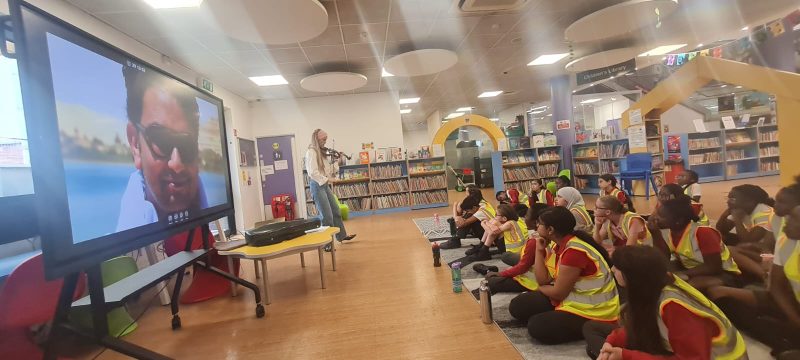
About Ruth Palmer And Last Rose
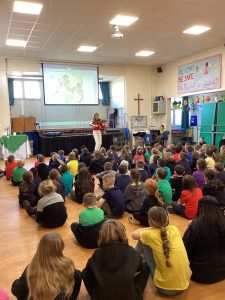
In her free Last Rose performance workshops in libraries, Palmer plays the Irish folksong The Last Rose Of Summer to illustrate the story she’ll tell about the champions of the Sinai Wild Rose. Egyptian scientists led by Dr Karim Omar have been battling floods and overheating to save it from climate change. The rose’s salvation came from the local community, the Jebeliya Bedouin.
Palmer’s performances are part of her ongoing production Last Rose, a multi-media music and arts quest working initially with libraries and later with other artists. Palmer is a critically acclaimed international recording artist and has appeared worldwide in television documentaries including a film about violins narrated by Rosamund Pike. She first rose to prominence as prize-winner of the Royal Over-Seas League followed by a Classic BRIT. She’s performed for Queen Elizabeth II and King (then Prince) Charles, and is well-known for her conceptual ability to project the fine art of violin interpretation into other branches of the arts to spotlight the music’s inspiration. She has revised her unpublished, unedited book Letters To A Young Violinist eight times, and is still unsure whether or not it should see the light of day.
*****
Issue 30, featuring Gillian McAllister, is out now. You will be able to find it in libraries and other outlets. Alternatively, all current and previous editions can be found on our magazines page here.

You can hear great new ideas, creative work and writing tips on Write On! Audio. Find us on all major podcast platforms, including Apple and Google Podcasts and Spotify. Type Pen to Print into your browser and look for our logo, or find us on Podcasters.Spotify.com.
*****
If you or someone you know has been affected by issues covered in our pages, please see the relevant link below for information, advice and support: https://pentoprint.org/about/advice-support/