Write On! interviews Famya Faiz
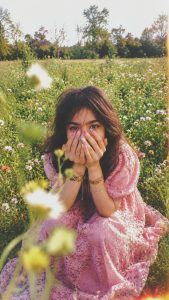
I write poetry first and everything else second. It’s where I learned to pay attention: to small things, to the weight a single word can carry – and it’s still how I think, even now prose has crept in. Come Back is one of those ventures, a short story that won the ‘Author Of Tomorrow’ award from the Wilbur and Niso Smith Foundation, which remains the only time a space metaphor has taken me anywhere. I’m a very maths- and science-oriented person, so writing feels like a breath of fresh air and I hope to always have the ability in my back pocket.
WO: How would you describe your writing to someone new to it?
FF: I usually describe it as taking ordinary things and giving them a gentle shake. My stories tend to start somewhere everyone recognises: a kitchen, a walk home in the evening, a library, and then I let one small strangeness in. I love the moment a reader realises the world on the page isn’t quite the one they walked in with. Nothing explodes, but by the end, the street outside your window looks faintly different than it did before you started reading.
WO: Can you tell us a bit about your latest work?
FF: Come Back is, at its heart, a metaphor. An astronaut is on a space mission and he loves it, until he realises he loves something else even more: home. Space is the biggest dream a person can have, and home is the most ordinary thing there is and, somewhere over the course of the mission, his affections change sides. It came about when I was thinking about what distance does to us, how you sometimes have to leave a thing entirely before you can see how much it weighs. Astronauts talk about looking back at Earth and feeling this ache for it, and there’s something very tender in that to me; this huge impossible journey ending in a longing for your bed. We tend to assume the great adventures are the ones that carry us furthest, but the return is an adventure too, and a stranger one.
He doesn’t love the stars any less, exactly; he just discovers his heart was keeping a seat warm for somewhere else the whole time.
WO: What inspired you to write in the first place, and what inspires you now?
FF: In the beginning, it was probably greed. I realise this sounds bad, but I read stories when I was younger that opened all these doors and I wanted a door of my own! I was always making up new endings for books I refused to finish. At some point, making things up stopped being a game and became the way I think. What inspires me now is smaller and stranger, usually a sentence I’ve overheard, or something that has no fantastical prospect – at first glance, at least. The mundane does the job perfectly well if you’re willing to stare at it long enough, and it never runs out.
WO: Our last issue of Write On! explored the theme of Nostalgia, reflecting on the often rose-tinted view we have of the past. How important do you think it is to acknowledge what came before in your own writing? Or do you think nostalgia can hold you back from moving forward?
FF: I think nostalgia is a tool and, like most tools, it can build a house or break a window. The past is the raw material of nearly everything I write, because I don’t believe you can write about a person or a situation honestly without writing what inspired it and tying it to your own emotions,. Memory is never neutral. What I try to avoid is serving nostalgia instead of using it, and trying to make narratives that exist to be warm rather than true, where the past could belong to anyone. In Come Back, my character wants the past back and spends the whole story learning the difference between returning and mourning. As material, it’s generous to a fault. As a place to live, it’s a museum with terrible heating, so I’m always wary of using my own experiences or things akin to it.
WO: What one piece of advice would you give an aspiring writer?
FF: It’s something I haven’t fully accomplished yet, but not overcomplicating things is something I’ve always found tricky. We often tend to create these opulent worlds which are so detailed, but translating them into words often causes a block, which can be pretty discouraging. I’d say simplifying or sanding down an idea isn’t necessarily something to be scared of; it can always be implemented elsewhere. The main goal is to just keep writing until the end. An imperfect finished story teaches you more than a beautiful half-finished one, because you can only see what you actually made, as opposed to what you meant to make, once there’s an ending to stand back from. Also, always keep a notebook or even a note on your phone handy, so you can write down an idea as soon as you get it.
WO: Can you tell us anything about future projects?
FF: At the moment, I’ve reverted to my roots and have been exploring more poetry as opposed to prose, but with various lenses I haven’t explored before: different structures, different tones (none very happy, unfortunately). Story- wise, though, I’ve yet to go on my next adventure. There’s been a short story in the works that has challenged me because it involves more implicit ideas; the main theme being a large sense of confusion for both reader and character!
WO: Lastly, if you could choose one fictional animal/creature to be a pet or companion, who would it be and why?
FF: Stitch from Lilo And Stitch is so cute and it brings back many memories to think about the movie. I just remember loving him so much because of how cool he is. Plus, he’s probably more agile than me! And he’s just so kind and round and blue, who wouldn’t adore him?
*****
Issue 30, featuring Gillian McAllister is out now. You will find it in libraries and other outlets. Alternatively, all current and previous editions can be found on our magazines page here.
You can hear great new ideas, creative work and writing tips on Write On! Audio. Find us on all major podcast platforms, including Apple and Google Podcasts and Spotify. Type Pen to Print into your browser and look for our logo, or find us on Podcasters.Spotify.com.
*****
If you or someone you know has been affected by issues covered in our pages, please see the relevant link below for information, advice and support: https://pentoprint.org/about/advice-support/