Write On! Features: What The Movies Taught Me by Dimitri William Moore
- 9 October 2026
- News, WriteOn Features
How a lifetime of film-watching became a published book — written entirely on a phone.
By Dimitri William Moore
Let me be clear about something from the start: I am not a writer. I wrote a truly terrible screenplay in high school – I mean genuinely bad – and a handful of poems in my 20s that I will not be sharing with anyone beyond a couple of Medium posts. Beyond that, nothing. No creative writing classes, no journalism, no blog. Writing a book was never part of the plan, because there was no plan. And yet, here we are.
A year ago, a friend told me she felt guilty about how many films she watched. “I waste so much time on movies,” she said. I asked her one question: did she enjoy them? When she said yes, I told her it wasn’t a waste of time at all. Enjoyment is never wasted. She smiled, and that was that – just a passing exchange. But something in that moment stayed with me.
A short while later, I was at Ecstatic Dance – a sober rave where the music moves you and, if you’re lucky, so does something inside your head. I was dancing when it hit me with total clarity: films had always been more than entertainment to me. They’d been a kind of private language, a way of making sense of the world. And, quietly, a source of wisdom I’d been drawing on my entire life without ever putting a name to it.
That was the night I decided to write Lessons In The Lines.
A Language I’d Been Speaking For Years
I’ve been watching films my whole life. But more than watching them, I’ve been carrying them. Lines from films have a habit of surfacing at exactly the right moment: in a conversation with a friend who needs encouragement, on a film set when the atmosphere gets tense, at a family gathering when someone is struggling and the right words are hard to find. I’ve always instinctively reached for a line from a film. Not to be clever but because it was true.
The book grew from that instinct. I wanted to share over 130 of those lines, from films and TV shows spanning decades and genres, and explore what they had quietly taught me about how to live. Not as a film critic but as someone who’d simply paid attention.
The themes that feel most personal to me are identity, resilience and parenting. These are the areas of life where I’ve found myself most lost and most found and where film has most reliably offered a hand. There’s something freeing about seeing your own experience reflected back through a story. Though it doesn’t fix anything, it tells you that you’re not alone in it, and sometimes that’s enough.
Written On A Phone, One Hour At A Time
I should tell you something about how this book was written, because it didn’t happen the way most people imagine books happen. There was no quiet study; no dedicated writing retreat; no long mornings at a desk with a pot of coffee and a clear view of the garden.
I wrote Lessons In The Lines on my phone, in stolen moments, over four months.
Buying a small portable keyboard, I made a list of my favourite and most impactful film quotes and then I wrote whenever I could. If I was meeting friends for dinner, I’d arrive an hour early and write two or three chapters at the table before they got there. If people were over at the house and I needed a moment to myself, I’d slip away and write. On public transport. In waiting rooms. In the gaps that most of us scroll through without thinking.
There was no grand routine. There was just the book and the time I could find for it. In many ways, that felt right. The book is about finding meaning in unexpected places. Writing it that way – in the margins of an ordinary life – seemed fitting.
A Birthday Post And Two Phone Calls
Finding a publisher was, I’ll admit, the part I least knew how to do. I researched, read articles, went in circles. The traditional routes felt opaque and I couldn’t find a clear way in.
So I did something that felt equal parts vulnerable and practical. On my birthday, I posted publicly for the first time that I was writing a book. I told my network what it was about and asked if anyone could introduce me to a publisher.
Two friends responded. One had a contact in the UK. The other had a contact in New Jersey. I spoke to both. One of those conversations changed everything. Michael, the publisher in New Jersey, immediately understood what I was trying to do; not just the concept, but the spirit of it. He got why the lines mattered and knew how to shepherd a first-time author through a process that, from the outside, can feel entirely unknowable. That was the person I needed.
I tell this part of the story whenever I speak about the book, because I think aspiring writers need to hear it. The path doesn’t always look like the path. Sometimes it looks like a birthday post.
What The Book Actually Is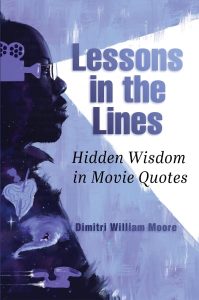
Lessons In The Lines is structured around themes rather than films. Each section takes a universal human experience – grief, hope, identity, resilience, friendship, parenting – and works through a series of film and TV lines that illuminate it. For each quote, I share the context: where it comes from, what’s happening in that moment and what it came to mean to me beyond the screen.
It’s not a film guide, nor is it a self-help book, exactly. It sits somewhere in between: part personal meditation, part love letter to cinema, part invitation for the reader to do the same thing I’ve been doing my whole life – listening to what the stories are actually saying.
I hope readers will finish it and come to think differently about the films they’ve already seen. That they remember a line from something they watched years ago and suddenly understand why it’s stayed with them. That they feel, perhaps, a little less alone in whatever they’re carrying.
For Anyone Who Has Ever Thought About Writing
When I talk about writing this book, people often say some version of the same thing: “I’ve always thought about writing one.” I understand that feeling. The gap between thinking about a book and starting one can feel enormous. But I didn’t start with a plan. I started with a list of quotes and a portable keyboard and a free hour before dinner.
The book you want to write is already inside you. You just need to find the moments to let it out.
That’s what the films taught me too, in the end. The answers are usually already there. You just have to learn to listen.
Lessons In The Lines by Dimitri William Moore is available now.
Follow the book on Instagram: @lessonsinthelines
*****
October is Black History Month: Honouring Our Communities. This is taken from the Black History Month official website:
Black History Month 2026 invites us to look more closely at something we often take for granted: the communities that shape, support and sustain us.
This year’s theme, ‘Honouring Our Communities’, is not simply about place or postcode. It’s about people. Black people. It is about recognising individuals whose contributions are part of everyday life, yet too often go unseen.
For many years, Black History Month has rightly celebrated notable figures whose achievements have changed the course of history. That recognition remains important. But history is not only made in moments of visibility. It’s built over time, through consistent acts of care, leadership and responsibility.
Across Britain, there are black individuals who show up every day for others. Volunteers who give their time without expectation. Teachers who shape futures far beyond the classroom. Nurses and carers who offer dignity and compassion in moments that matter most. Community leaders and organisers who bring people together, often working quietly, without recognition.
These are the people who help to hold our communities together.
Find out more and how you can get involved here: blackhistorymonth.org.uk
*****
Issue 30, featuring Gillian McAllister, is out now. You will be able to find it in libraries and other outlets. Alternatively, all current and previous editions can be found on our magazines page here.
You can hear great new ideas, creative work and writing tips on Write On! Audio. Find us on all major podcast platforms, including Apple and Google Podcasts and Spotify. Type Pen to Print into your browser and look for our logo, or find us on Podcasters.Spotify.com.
*****
If you or someone you know has been affected by issues covered in our pages, please see the relevant link below for information, advice and support: https://pentoprint.org/about/advice-support/