Write On! interviews musician Ruth Palmer
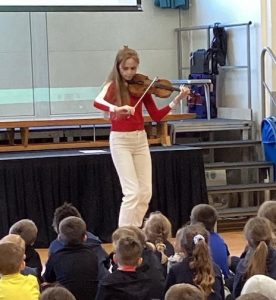
Palmer is a critically acclaimed international recording artist and has appeared worldwide in television documentaries, including a film about violins narrated by Rosamund Pike. She first rose to prominence as String prize-winner of the Royal Over-Seas League (ROSL) followed by a Classic BRIT. She’s performed for Queen Elizabeth II and King (then Prince) Charles, and is well-known for her conceptual ability to project the fine art of violin interpretation into other branches of the arts to spotlight the music’s inspiration.
WO: How would you describe your violin performance workshop to someone new to it?
RP: I’m bringing a good news story of an Egyptian local community and ancient multicultural library, to UK local libraries and communities. The audiences range from retirees to school children. The story is about the Sinai Wild Rose, endangered by climate change and the power of community helping to save it. Despite being 3,000 miles apart, the Egyptian and UK communities are united by the common values of collaboration, inclusiveness and invaluable secret wisdom. I’m illustrating the story with an Irish folksong called The Last Rose Of Summer that has virtuosic violin variations which I perform and I’m introducing poetry via Thomas Moore’s lyrics of the song, joining National Year Of Reading 2026. I’m very grateful to London Borough of Barking and Dagenham for being so proactive in bringing Last Rose In Libraries to a wide audience in the borough.
WO: Can you tell us a bit about your latest project Last Rose?
RP: It’s a multi-media music and arts quest starting with Last Rose In Libraries, which is the work you’re featuring – thank you! The endangered Sinai Wild Rose grows next to a Bedouin community called the Jebeliya, who live in the St Catherine’s Protectorate in the Sinai Desert. Together with Egyptian scientists led by Dr Karim Omar, they became crucial to the rose’s survival because of their hidden knowledge.
WO: What inspired you to run these workshops in the first place, and what inspires you now?
RP: I’m inspired by the Jebeliya Bedouin, who held the secret to the rose’s propagation. They’ve lived at Mount Sinai where the rose grows since the sixth century, because they were appointed guardians of St Catherine’s Monastery by Byzantine Emperor Justinian I. The monastery has one of the oldest libraries in the world, including letters from Mohammad and Napoleon. King Charles III is now their Foundation’s Royal Patron; making it a shining example of multiculturalism. The way the Jebeliya who protect the ancient library as part of the monastery went beyond their duty and came together with the scientists led by Dr Karim Omar to protect the Sinai Wild Rose endangered by climate change, awakened me to how precious our communities and libraries are in the UK. No one walks into a library and is told that a book may not be read because of the ethnicity or social status of the author or its reader. UK Libraries accept and include everybody and that inclusiveness holds secret power, because wisdom is unbiased in choosing its advocates – as demonstrated by the transformative story of the Sinai Wild Rose.
WO: Recently Write On! explored the theme of ‘Borrowed.’ Creatives inevitably draw on stories, structures and voices that have come before them. How do you navigate influence while maintaining a distinct creative voice?
RP: The violin is my centre of gravity and the engine of my personal growth. As a classical musician, I draw on over three centuries of composers expressing every possible emotion and concept. I can choose and attach myself to the composers’ repertoire that reflects my spiritual and psychological status quo, for catharsis, and to witness and acknowledge shared experience through performance. The most influential of my violinistic forbears made recordings between about 1930 and 1980 and it’s their idiosyncrasy and spirit that influenced me the most; from them I take permission to follow my intuition. Current violinists performing I admire include: Viktoria Mullova, Alina Ibragimova, Lisa Batiashvili and Sergey Khachatryan, who have a deeply personal, even spiritual, relationship with their art.
But my influences are wider than that. Given the extreme discipline and narrow focus necessary to become a violinist and stay on form, I’ve sometimes found myself looking for ways to broaden my experience of life. Looking outside music allows me to be curious at an amateur level, to explore the things I love and enjoy more spontaneously. This pulls me out of my (sometimes too serious) artistic comfort zone. When I do that, there’s an inevitable parallel development in my playing; I sense greater musical enjoyment and enthusiasm when I allow myself to seek lightness in my life outside it. Violin playing is a mirror of everything that happens in my life, even when that is not my intention!
It was at one of these junctures Last Rose came into being. I asked myself what I loved about life and what I cared about. The answer was nature, beauty, a sense of awe, and people, which I extended to believing in, protecting, and celebrating creative, hopeful people. I found the rose on the IUCN Red List for endangered species during a break while practising The Last Rose Of Summer. I’d started to see vulnerability as a strength – and the Sinai Wild Rose and its story is a good representation of that. Last Rose gives me the opportunity to admire environmental scientists such as Dr Karim Omar, the Jebeliya Bedouin, local communities and poets, without needing to be an expert myself. It opens my music-making to the wisdom and welcome of community.
It was only after creating the project I realised Last Rose chimes with a number of stories – The Little Prince, for example. So to your point of interacting with other people’s work, the sequence is: I use my art developmentally and cathartically, interpreting composer’s compositions as part of that process. I’m led to a creative project instinctively, expanded by curiosity and desire. Only then do the archetypes shared with other people’s work in multiple disciplines become obvious. I think it’s important it’s that way round: your heart first, then other people’s influence. This maintains the integrity of your work.
While allowing for the relationship with the greats such as Bach, I’d say a sure-fire way to know you’re not doing the ‘real work’ is if you’re tempted to copy someone out of envy or competition. Intention is everything. On the other hand, I think archetypes exist beyond the short lives we experience and are measured in millennia not centuries. I’m not sure they’re really borrowed; rather that we’re part of them. Maybe they’re borrowing us!
WO: What one piece of advice would you give an aspiring performer?
RP: Listen to your intuition. If your performance discipline requires commitment from childhood, you need to become very good at working out what it is you really want and what is being imposed by others’ expectations. This includes your desire to become a performer. Don’t do it if you can’t feel it! Be kind to yourself, so you can listen to the part of you leading you on your path. This can be extremely tricky if the (often adult) people around you don’t give you the space to do so, but it is the only path to sustained success. As an artist, your intuition is your gift. There’s no daylight between the two. Don’t force. Let yourself be attracted naturally to the things you love.
WO: Can you tell us anything about future projects?
RP: Last Rose film and tour in development for 2027.
WO: Lastly, if you could choose one fictional animal/creature to be a pet or companion, who would it be and why?
RP: Black Beauty, because of the way he keeps his goodwill and beautiful spirit intact in the face of suffering and cruelty. It’s a lesson in dignity.
You can find out more about Ruth Palmer here: ruthpalmer.com and connect on Instagram: @ruthpalmerviolin
*****
Issue 29 of Write On! is out now. Featuring an interview with travel author Tharik Hussain the theme is ‘ Borrowed’ and you can read it online here. Find it in libraries and other outlets. You can find previous editions of our magazines here.

You can hear great new ideas, creative work and writing tips on Write On! Audio. Find us on all major podcast platforms, including Apple and Google Podcasts and Spotify. Type Pen to Print into your browser and look for our logo, or find us on Podcasters.Spotify.com.
*****
If you or someone you know has been affected by issues covered in our pages, please see the relevant link below for information, advice and support: https://pentoprint.org/about/advice-support/