 Hello! I’m Jaclyn Rajsic, a medievalist based at Queen Mary University of London and a scholar of medieval legendary histories of England and Britain. I love exploring how medieval legends develop over time and shape understandings of places and histories.
This is my first Showcase, and I’m thrilled to introduce our new theme of ‘Fractured.’ So much comes to mind when I think about this theme: fractured identities, histories, relationships, memories and politics, to name but a few. With fracture, though, also comes repair. What might fill the cracks or spaces between those missing pieces? And what emerges as a result?
I’ve been thinking about this in relation to London, a city made up of all kinds of pieces from different periods in history. The Great Fire in 1666 destroyed much of the medieval and early modern city; The Blitz ripped the city to shreds. For centuries, London has been rebuilt, expanded and redesigned on and around the fractured pieces of its past.
My favourite example of this is Guildhall Art Gallery. The original Victorian gallery was destroyed in 1941; in 1988, when it was being rebuilt, archaeologists discovered ruins of London’s ‘lost’ Roman amphitheatre.
London has many layers, many histories, many stories. The visible contrasts, connections and fracture lines between the Londons – old and new – give us a city that is ever surprising and transforming. It transforms through stories, too.
King Lud And His Sons
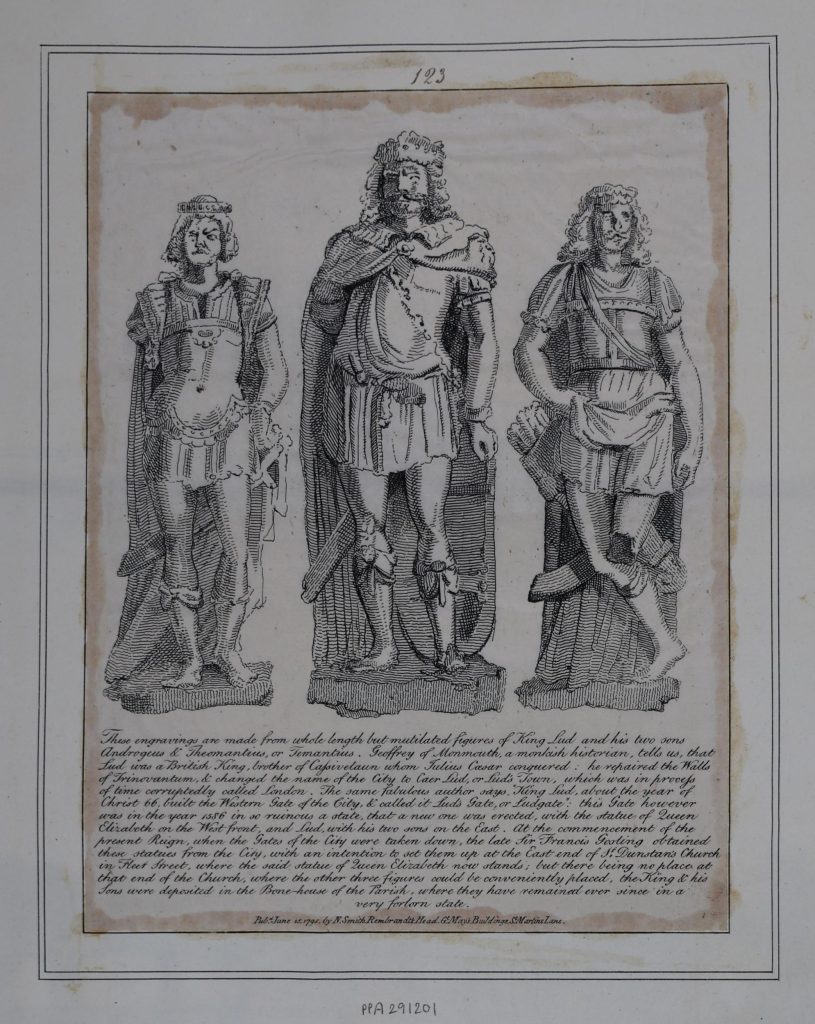
According to late-medieval legends, both London itself and Ludgate (the walled city’s most westward gate) take their names from a British king called Lud, who ruled in the first century BCE (before the coming of the Romans). Legends rewrote history. In his invaluable Survey Of London (1598), John Speed wrote that Lud not only repaired this city, but also increased [it] with fair buildings, towers and walls. Just as Lud transformed stories of London’s ancient past, so too did he transform the city’s architecture. In the engraving shown here (from 1795), printmaker John Thomas Smith described Ludgate in 1586: it was in so ruinous a state that a new [gate] was erected, with the statue of Queen Elizabeth on the west front, and Lud, with his two sons on the East.
By Smith’s own time, the statues of Lud and his sons had become mutilated figures. Ludgate had been demolished in 1760 (a blue plaque on the wall of the church of St Martin within Ludgate marks its original site). But pieces survived through the statues: Elizabeth, Lud and his sons were moved after the demolition; they can still be found in St Dunstan-in-the-West on Fleet Street. Fragments of the past remain tucked within the city – we just need to know where to find them.
*****
We begin with a lovely piece looking back to the past, with memories of a childhood in London. The memories are fragmentary, but together they offer windows into an earlier London that can only be retrieved through memory. London feels sprawling when explored by foot (walks up, down and across the city are numerous), but its parks and gardens bring pause, play and peace. The divides between city and nature, past and present, depict a London remembered not for its famous sites or landmarks but rather for the opportunities it offers for deep connections with nature. Those connections – the city – shape who we are.
Mainly Outings
Living in more or less central London wasn’t a bad place to live from lots of points of view. But one misconception I must put right for non-Londoners is to point out that, although we were only a few miles away from the West End, anywhere we wanted to go involved a lot of walking – and especially if one had a mother like mine, who would rather walk a mile than spend an extra penny on bus fares. It was a good ten minutes’ walk to the nearest bus stop on Camden Road, and at least a mile to Camden Town. It was even further to the shopping centre in the other direction, Holloway or the Nag’s Head, as my grandmother used to call it. It was a wonder my legs weren’t worn down to stumps.
But I do remember travelling on the underground when I was still so small that the backs of my knees came nowhere near the edge of the seat, making my feet stick out into the standing area. I remember Kensington Gardens being one of my favourite places, with the Elfin Oak (in those days not behind bars), Peter Pan’s statue and the Round Pond. Best of all, there was a big playground with lovely, but probably desperately unhygienic, sandpits.
Playgrounds in those days were very dangerous all round, but were probably much more fun. The solid child swings with an arrangement of pull-down bars probably weighed as much as the child that was put in it, and woe betide anyone who was hit by them! The ordinary swings were also made of solid wood, and there was just ordinary asphalt to land on if you fell.
Of the parks, Regent’s Park was my favourite, with the ‘Broad Walk’ lined with huge banks of flowers and curly, green-painted benches to sit on. Then, when I was older, I discovered the magic of ‘Queen Mary’s Gardens’ or ‘The Rose Gardens’, as they were mostly called.
In the Rose Gardens, there was a wonderful statue of writhing athletes being attacked by huge snakes, with the water from the fountain spouting dramatically all around them. It was surrounded by quiet benches and tall walls of ivy. My mother used to sit back on one of the benches and say: “Who would think we were in the middle of London!” And indeed, there would be no one there but us, and the only sounds to be heard would be the splashing of the fountain, birdsong and the gentle rustling of the ivy in the summer breeze.
Something a little more tiresome happened during one of our walks over Parliament Hill Fields and Gospel Oak. Where one ended and the other began, I was never quite sure. It was the same with Kenwood House, which was also in that area. In the general direction of Kenwood are a series of ponds. They are the source of the Fleet River, which runs under Fleet Street and flows into the Thames, so my mother used to tell me. She was always knowledgeable about such things.
Two of the ponds had been turned into swimming pools, one for men and one for ladies. They exist still, with the ladies’ one sporting a very prominent notice: No men beyond this point.
Anyway, this pond where I was playing at about the age of three or so had a rather inviting tree, with a lovely, low branch jutting right out over the water. I couldn’t resist, and soon I was clambering along it. I don’t remember a great deal more, except being hauled out of the pond by a very irate parent and a helpful passer-by.
Looking back, I realise how important these outings were for me. I grew up knowing not only how grass, flowers and trees looked, but how they smelt, what they sounded like when the wind blew or the rain fell, and how it felt to lie flat on my back in the long wilder grass of Hampstead and Kenwood and see nothing but the sky and the clouds above. In short, to have the privilege of knowing how it feels to be at one with nature during my early childhood when such impressions leave an indelible mark.
(c) Josephine Renton, 2008
Taken from Blog: https://postwar-londonchildhood.blogspot.com/2008/04
*****
Our next piece moves us from an insider’s view of London to a view from America. Destiny describes exploring and getting to know London in parts: through stories, films, music, art and online communities. From past to present, the London that emerges is open and inviting, yet the speaker is always at a remove from the city itself. There are some cities we will only encounter from a distance and through stories; yet they hold power over our imaginations.
An Outsider’s View Of London

As someone who’s never been to London, I’ve seen fragments of it from a distance. When I think of London, the first things that come to my mind are the British Invasion (and those amazing New Wave groups in the 80s!), the cockney accents, teatime and The Beatles.
As a kid, I was pretty fascinated with the concept of London. I remember watching Mary Poppins and taking in all the differences of British culture. Even though Dick Van Dyke’s cockney accent was far from the real deal (something he laughed and joked about later on in life), I listened to it and thought it was so unique. That was one of my earliest exposures to the culture of London. As I became older, I got more into the music and art that came from it.
For people in America, I think London is often associated with a very creative and different culture. Some musicians, such as Jimi Hendrix, even felt London was like a second home, a space to have the freedom to create. London seems a more open place, a world where the eccentric outsiders can find a community.
Although I’ve never visited London, I’ve often been drawn to it. Meeting people online who live there has been a fun and fascinating experience. Despite the differences in accents and cultures, we end up getting along well, especially if we’re both in creative fields such as art and writing. I’ve noticed a deep respect in London culture for the literary arts, and that’s refreshing to experience. In American culture, we sometimes take the arts for granted, and may not put as much financial support behind them. But in London and the UK, I see all kinds of organisations devoted to making sure the arts are still thriving throughout the community. Art is not considered a static idea from the past: instead, it’s a timeless creation worthy of preserving.
Even in the main monuments of London, such as Big Ben, there’s something timeless about them – a piece of the past that’s still honoured and valued today. Rather than forgetting about the old clock, people cared for it throughout many changes and developments in London. It reminds me of the Statue of Liberty, one of the landmarks in the USA.
If you’ve never been to London, I would definitely suggest exploring the culture, even if you have to do it from your home town. Thanks to the internet, we have access to much more knowledge on different cultures around the world. You can still learn about London and dive into its captivating quirks, even if you haven’t been there yourself.
(c) Destiny Hankerson, 2026
*****
To conclude, I want to offer a picture of different city, thinking more about the power of our imaginations to shape our perceptions of place. This is one of my favourite medieval poems, an Old English elegiac poem called The Ruin. The poem itself is something of a ruin. It survives only in one manuscript, The Exeter Book (c. 975), and the parchment is damaged. Somes lines are unreadable as a result.
The Ruin brings us back to Roman times, in the distant past…
Splendid this rampart is, though fate destroyed it,
The city buildings fell apart, the works
Of giants crumble. Tumbled are the towers,
Ruined the roofs, and broken the barred gate,
Frost in the plaster, all the ceilings gape,
Torn and collapsed and eaten up by age.
And grit holds in its grip, the hard embrace
Of earth, the dead departed master-builders,
Until a hundred generations now
Of people have passed by. Often this wall
Stained red and grey with lichen has stood by
Surviving storms while kingdoms rose and fell.
And now the high curved wall itself has fallen.
. . .
The heart inspired, incited to swift action.
Resolute masons, skilled in rounded building
Wondrously linked the framework with iron bonds.
The public halls were bright, with lofty gables,
Bath-houses many; great the cheerful noise,
And many mead-halls filled with human pleasures.
Till mighty fate brought change upon it all.
Slaughter was widespread, pestilence was rife,
And death took all those valiant men away.
The martial halls became deserted places,
The city crumbled, its repairers fell,
Its armies to the earth. And so these halls
Are empty, and this red curved roof now sheds
Its tiles, decay has brought it to the ground,
Smashed it to piles of rubble, where long since
A host of heroes, glorious, gold-adorned,
Gleaming in splendor, proud and flushed with wine,
Shone in their armor, gazed on gems and treasure,
On silver, riches, wealth, and jewelry,
On this bright city with its wide domains.
Stone buildings stood, and the hot steam cast forth
Wide sprays of water, which a wall enclosed
In its bright compass, where convenient
Stood hot baths ready for them at the centre.
Hot streams poured forth over the clear grey stone,
To the round pool and down into the baths.
(c) The Ruin, translated by Richard Hamer, in A Choice Of Anglo-Saxon Verse (1970).
*****
I look forward to sharing more pieces next week! We will continue to think about time, loss and memory, as we approach our theme of ‘fractured’ from different angles.
*****

You can hear great new ideas, creative work and writing tips on Write On! Audio. Find us on all major podcast platforms, including Apple and Google Podcasts and Spotify. Type Pen to Print into your browser and look for our logo, or find us on Podcasters.Spotify.com.
*****
If you or someone you know has been affected by issues covered in our pages, please see the relevant link below for information, advice and support: https://pentoprint.org/about/advice-support/